


Made with AI trained only on my own artwork. The honest story of how, and why →
People ask me, fairly often, what I do for a living.
I tell them I write things down. They nod politely and change the subject, which is fine with me. If I told them the whole truth, we’d be there for three days and I’d miss dinner.
The whole truth is this: I work for the Fishis Archive Foundation. I am one of twelve Fishis. I have been doing this job for forty-seven years and I have not, not once, considered doing anything else.
Not seriously, anyway.
There was one afternoon in a collapsed aqueduct in the Outer Reaches where I reconsidered briefly, but that passed once I got my arm working again.
The FAF is not an easy thing to explain to someone who didn’t grow up inside it. So I’m going to try anyway.
Consider this your orientation.
You’re welcome.
What the Fishis Archive Foundation Actually Is
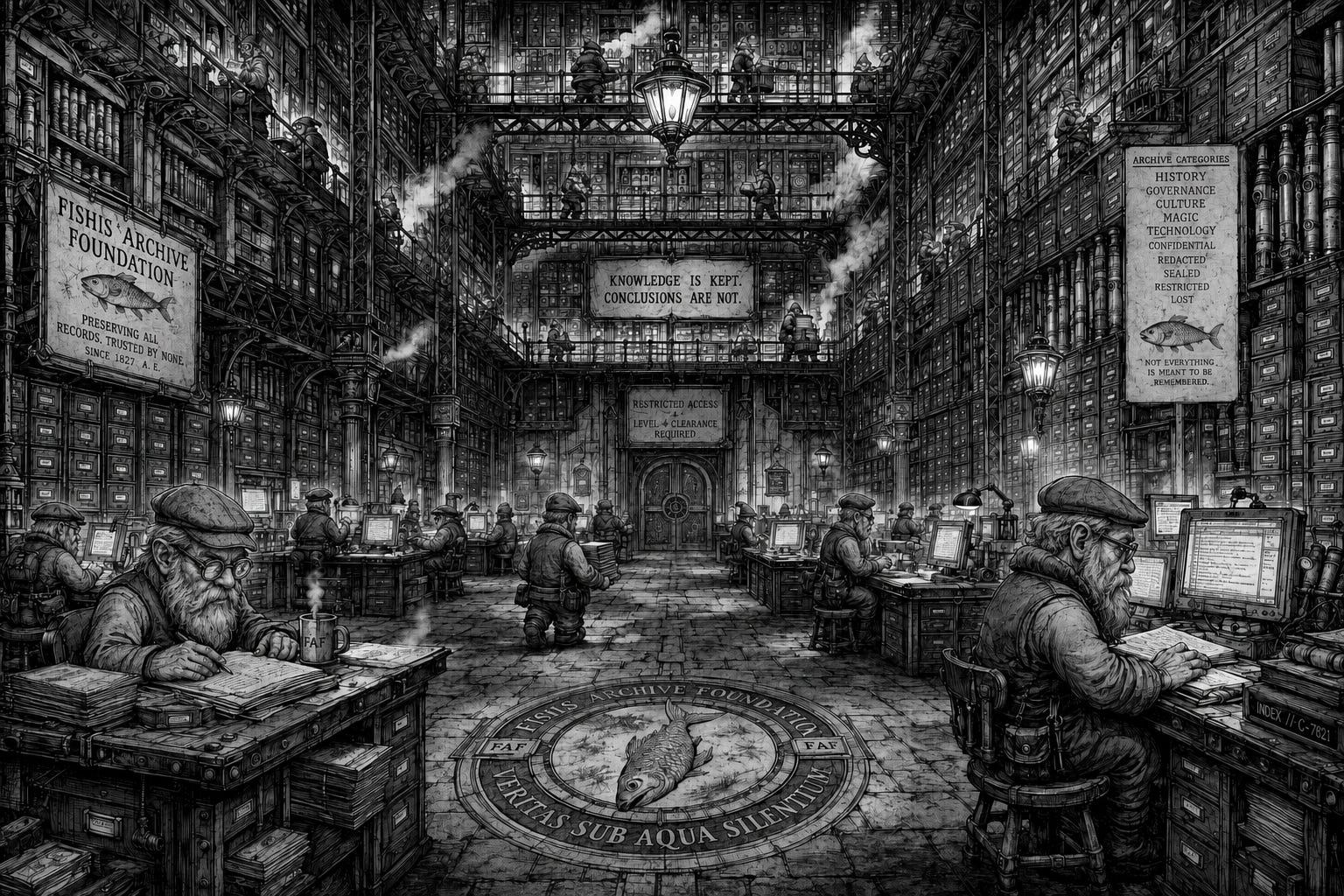
The Fishis Archive Foundation is the central information institution of the gnome people.
I don’t mean that loosely.
I mean: if something happened, if someone existed, if a place was mapped, a treaty was signed, a guild was formed, a king was crowned or quietly removed…the FAF has a record of it. Somewhere in those halls, behind one of approximately six thousand employees and several locked doors, is a document that knows the truth of it.
The FAF collects history. Not the polished version governments prefer, not the entertaining version bards sell, not the vague moral lesson your grandmother summarized over dinner.
History.
Documented, dated, cross-referenced, and filed.
Founded in the years before the Great Clockwork Chime Tower was built…before ChimeTime existed, before the districts had names, before Clockwork City was anything more than a cluster of very stubborn gnomes with an engineering problem and too much ambition…the FAF began as something much simpler.
Record keepers.
Scribes who wrote down what they witnessed because someone had to and nobody else was doing it carefully enough.
Then came the genealogists. Then the archivists. Then the scholars who realized that individual records, when collected together, revealed patterns that no single document could show alone.
Then came the Foundation.
The FAF today operates out of a multi-floor archive in Clockwork City…a building with hundreds of monitors, restricted databases, open plan desks for the staff, and a sub-level that most employees don’t have clearance to know exists. Approximately six thousand gnomes work there that the public knows about.
More than 30,000 more that they don’t.
The institution is exclusive to gnomes. No other race is granted access to the collections, and non-gnomes are not employed in any research or archival capacity. This is not arrogance. It is a matter of institutional integrity that has been debated, challenged, and upheld for longer than some nations have existed.
Access to FAF records is tiered and tightly regulated. What the general public can see is a fraction of what exists. What senior researchers can access is a fraction of what the restricted databases hold. And what sits below the restricted level... I have opinions about that.
I keep them to myself, mostly, because I value what remains of my welcome.
The FAF is nominally affiliated with the Clockwork City government faction. I say nominally because the relationship is complicated in the way that all relationships are complicated when one party has information the other party would very much prefer stayed buried.
The FAF maintains that it is politically neutral by charter.
The government maintains that the FAF is cooperative and grateful.
Both parties understand that this arrangement continues only as long as both find it useful.
I find this quietly hilarious and have written about it exactly nowhere in any official document.
The Problem With Institutions
Here is the thing about any organization large enough to matter: it develops interests of its own.
The FAF is no exception.
Depending on who is running the place at any given time, certain information gets... managed. Reviewed with unusual thoroughness. Filed in locations that require escalating levels of authorization to reach. Occasionally, a document that should exist simply does not appear in any searchable record, and no one in the building seems to know why.
I have personally experienced this three times. Once with a trade record that implicated a senior council member in a fraud scheme spanning forty years. Once with a biological survey of a district that no longer officially exists. And once with my own work, which I will not detail here because I am already on thin enough ice with the current administration.
The FAF collects truth.
What it does with that truth depends entirely on who holds the pen at the top.
This is why the Fishis exist.
The Fishis
We are not administrators.
We are not archivists or cataloguers or reviewers or any of the other thousand job titles the FAF has invented to keep its six thousand employees feeling purposeful. Those are fine people doing necessary work.
They are not us.
There are twelve Fishis in total. We are the field scholars…the ones who go out into the world and bring the record back. The name comes from an old gnomish phrase for those who dive into deep water. The kind of water where the light doesn’t reach and most sensible creatures don’t go.
We go there.
We bring back what we find.
Each Fishi has a specialty. One knows creatures and biology better than anyone alive. One knows political structures and faction mechanics with a precision that would make the government nervous if they thought about it long enough. Others specialize in artifacts, in culture, in geography, in ancient languages, in military history. The eleven of them are extraordinary at what they do. They are the best scholars in the gnome world in their respective fields.
I have no specialty,…and I am the best at what I do.
I am told this makes me unusual.
History, biology, politics, artifacts, culture, language, geography, criminal enterprise, theological structure, and economic systems are known to me. I also hold a doctorate in field analytics and animal linguistics, as well as degrees in arcane analysis, magic fundamentals and advanced cybernetic adaptation and engineering.
I also make a mean quiche and an impressive lemon sorbet.
If it exists and someone needs to know about it accurately, I go and I find out. This is either a gift or a personality defect.
Possibly both.
I’ve stopped investigating the question.
What the twelve of us share: we are all famous. We are all independent. We have no leader and no hierarchy among ourselves. We are, every one of us, colleagues and friends…the kind of friendship that forms between people who understand exactly what the work costs and do it anyway. We have pulled each other out of bad situations on four continents and three occasions I am not legally permitted to describe.
We look to no one above us. We answer to the work.
I am, apparently, the one the others look to most often. Honestly, I find this baffling and have said so repeatedly. They continue doing it anyway.
I’ve given up arguing.
Handlers
Every Fishi has a handler.
This is not optional and it is not ceremonial. A handler is the operational layer between a Fishi and the Foundation…the person who cuts the deals, manages payment, navigates FAF bureaucracy, and delivers assignments to scholars who may be, at any given moment, in a collapsed aqueduct in the Outer Reaches with no forwarding address.
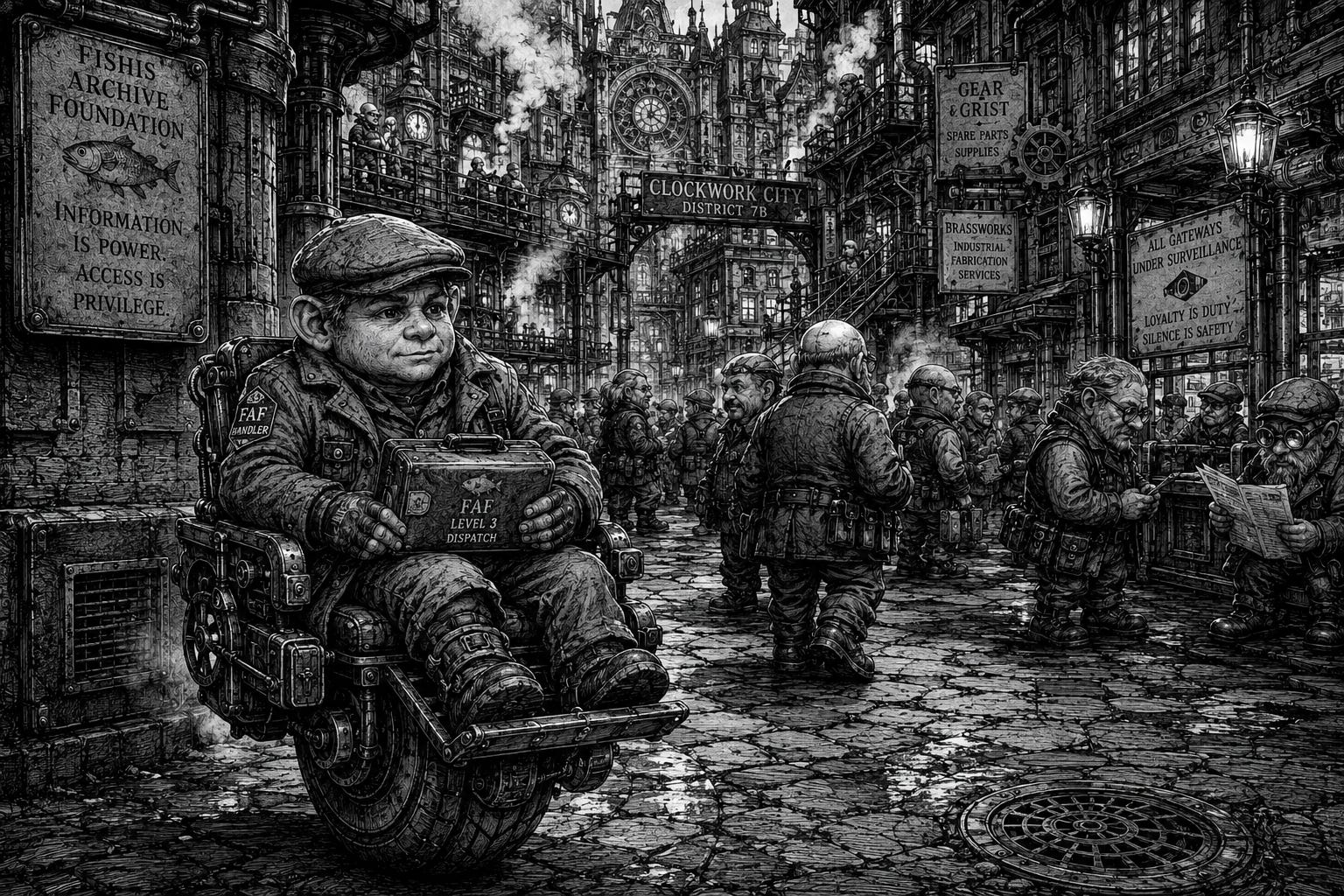
My handler is Damen Umbril.
He is younger than me by a considerable margin, which I find slightly offensive. He operates from a uni-chair, which the people who underestimate him find educational…because Damen has a talent for making problems disappear. I’ve never fully understood this and have never asked him to explain. He is clever, loyal, and has a moral position on the current state of gnome society that aligns closely enough with mine that we have never seriously argued about direction.
Only methodology.
Occasionally volume.
He is the perfect employee for this work. No one looks twice at him. No one expects a man in a uni-chair to be the covert operative managing the FAF’s most controversial field scholar.
This assumption has been deeply useful to both of us.
Our relationship is simple: He finds me the assignments no one else will take. I do them. The FAF gets results they cannot get any other way and pays us accordingly…Damen in credits, me in coin.
I don’t technically exist in the system anymore, but we make it work.
By any reasonable accounting, I’m the FAF’s top producer. They know it. I know it. Damen knows it. My colleagues know it. This knowledge is the quiet foundation of our ongoing arrangement.
The FieldScribe Order
Of the twelve Fishis, we are all members of the FieldScribe Order…one of several guilds operating under the FAF umbrella.
The Order is what distinguishes us from the scholars who stay inside. Archive Scholars organize and cross-reference. Cataloguers verify and classify. FieldScribes go out.
There are not many of us in the Order beyond the twelve senior Fishis. Field documentation is a specialty that attracts a particular kind of person and tends to shorten careers in ways that discourage casual applicants. Those who do join work under senior Fishis as associates, couriers, or research assistants. The Order maintains no permanent headquarters. We are, by definition, wherever the work is.
What we produce goes through the Foundation’s submission process: logged, reviewed, approved, patented. Every document we submit carries the official record: written for the FAF, the district we filed from, submission date in both Sundering and ChimeTime, submission number. When approved, it receives an approval record. When cleared for publication, a patent number…which is the final stamp that makes a document verifiably official, publicly accessible, and protected under FAF institutional authority.
This process exists because the FAF’s entire value rests on one thing: the verifiable integrity of its records.
Anyone can claim a document is official.
A patent number means it actually is.
My work has been submitted, reviewed, and approved many times over. The patent side is occasionally more complicated. I have views on why. The current administration has views on my views.
We manage.
Why This Matters
The FAF is not a library.
Libraries are pleasant places where knowledge sits quietly and waits to be asked for. The FAF is an institution with power, politics, budget pressures, and six thousand+ employees whose livelihoods depend on it continuing to function. It collects truth and it also, depending on the day and the person in charge, decides what to do with that truth.
The FieldScribe Order exists because the work of going out and finding the record cannot be done from inside a building. History does not file itself neatly into searchable databases. It sits in collapsed archives, in the notes of people who died without publishing, in the oral traditions of communities the gnome world has largely forgotten about, in the physical evidence of things that happened before anyone thought to write them down.
Someone has to go get it.
That is what we do.
We go get it.
We bring it back.
We write it down accurately, completely, and without regard for whose version of events it contradicts.
The FAF publishes what it publishes. The record exists regardless.
I have been doing this work for forty-seven years. I have been banned from my home city, paid under the table, worked through handlers, and filed submissions from locations I will not specify in a document with this distribution level.
I would not change any of it.
The work is not glamorous. It is not safe. It is frequently cold, occasionally explosive, and hard on the knees.
It is also the most important thing I know how to do.
So.
Welcome to the Foundation.
Try not to touch anything in the restricted section.
Höbin Luckyfeller is a Senior Fishi and FieldScribe of the Fishis Archive Foundation, District 9, Clockwork City. He is the author of Demoni Vankil, Bloodsticks, and numerous field reports filed under submission numbers the current administration would prefer you not look up. He can be reached through unconventional channels.