



I walked into this Fiction Cartel session feeling unusually optimistic—which, if you know me, should immediately raise suspicion.
But I meant it.
Something about crossing into 2026 feels different. Not louder. Not trendier. Just… clearer. Like a lot of the noise finally shook itself loose in 2025, and what’s left are writers who actually want to do the work.
We had a solid turnout, a relaxed room, and the kind of conversation that only happens when people stop pretending they’ve got it all figured out.
Tonight’s Panel:
Lisa / Deleyna Marr – Fantasy/Sci-Fi author, nonfiction writer, and founder of No Stress Writing Academy
Scoot / L.R. Scott (Gibberish) – Serial fiction madman, Flash Fiction Friday ringmaster, and chaos engine
Anne Kimbrough / Tell Me a Mystery – Mystery author, serial storyteller, and professional instigator
Ian Dunmore / Dunmore’s Dispatch – Fantasy short stories, worldbuilding essays, and unapologetic snark
Eric Falden / Falden’s Forge – Epic fantasy in short form, historical grounding, and thoughtful craft analysis
Jaime Buckley 💎 / LifeOfFiction.com / JaimeBuckley.com – Host, fiction writer, and guy who keeps inviting friends to talk about hard things
The question that started everything
Before we got anywhere near “strategy,” I asked something simpler:
How was 2025—for you, as a writer?
What followed wasn’t a highlight reel. It was honest.
Several panelists described 2025 as a scaffolding year—less about trophies, more about building systems, habits, and confidence. Progress showed up in quieter ways: improved process, stronger craft, better relationships with readers, and learning how to write alongside real life instead of waiting for perfect conditions.
One clear pattern emerged early:
production doesn’t have to explode to matter—but it does have to be sustainable.
Make sure to follow them, and subscribe to their substacks!
Subscribe to Eric Falden’s Falden’s Forge
Subscribe to Scoot’s Gibberish
Subscribe to Deleyna Marr’s Deleyna’s Drift
Subscribe to Ian Dunmore’s Dunmore’s Dispatch
Subscribe to Ann Kimbrough’s Tell Me A Mystery
Subscribe to Jaime’s Life of Fiction / JaimeBuckley.com
Highlights of the chat…
2025 was widely described as a “scaffolding year.”
Several admitted they didn’t publish as much as they expected to—but they built stronger processes, clearer thinking, and better habits. Fewer trophies, more foundation. That shift reframed “slow” as strategic rather than failed.
Serial fiction quietly dominated the success stories.
More than one panelist credited serialization with producing actual books—not just drafts. Writing in public created momentum, accountability, and a clear path from episodes to finished volumes. One panelist pointed out they’ve never produced books more consistently than after committing to serials.
Production increased even when profit didn’t (yet).
Some were candid about still “muddling through” financially—but also clear that production, consistency, and time usage had dramatically improved. The group repeatedly emphasized that profit is a lagging indicator, not a starting metric.
Short fiction was treated like a training ground, not a sidetrack.
Writing 15–20 short stories over a year sharpened craft fast. One panelist talked about opening an older novel and immediately seeing how much they’d improved—proof that volume plus reflection accelerates growth more reliably than endless polishing.
Burnout, life changes, and “the metagame of writing” were openly acknowledged.
New jobs, shifting schedules, and real-world pressure didn’t stop writing—but they forced adaptations. The group discussed navigating creativity when the muse is missing and learning how to write around life instead of waiting for ideal conditions.
Relationships mattered more than reach.
One of the strongest emotional throughlines of the session was how much writers valued conversations with each other. These weren’t networking moves—they were thinking partnerships that reshaped how panelists approached craft, feedback, and long-term direction.
Substack Notes came up as a personality filter, not a growth hack.
Some panelists leaned into Notes for discovery; others deliberately pulled back. The shared conclusion: Notes work best when used as conversation and play—not obligation. Muting, blocking, and disengaging were framed as healthy, strategic choices.
“Trickles” replaced the myth of the big break.
One of the clearest takeaways of the night was the rejection of overnight success narratives. Small, steady outputs—multiple trickles of work, audience touchpoints, and finished projects—were reframed as how sustainable careers actually form. A few trickles become a stream. Enough streams become a river.
AI wasn’t argued about—it was contextualized.
Rather than panic or hype, the discussion centered on understanding AI’s presence and refusing to live at the extremes. One panelist noted that even writers “against AI” are often already using it indirectly—whether they know it or not—and that clarity matters more than ideology.
SESSION NOTES: Ideas & Strategies in Publishing — 2026
Fiction Cartel Session: January 13, 2026
What’s actually working (even if it’s boring)
When we shifted into tactics, one word kept resurfacing:
Serializing.
For some, serial fiction became the most reliable way they’ve ever produced books—not because it’s glamorous, but because it creates accountability, reader connection, and forward momentum. Even small audiences made a difference. Knowing someone is waiting changes how you show up.
Others talked about rediscovering outlining—not as a creativity killer, but as a container. Having a structure helped keep stories within intended lengths and reduced burnout. The goal wasn’t speed for its own sake; it was finishing.
Short fiction also got its due. Several panelists credited frequent short stories with sharpening their skills, making weaknesses obvious, and forcing them to actually practice the craft instead of endlessly planning.
The takeaway was blunt:
writing regularly beats writing perfectly, and boring consistency compounds.
Notes, discovery, and the “person behind the keyboard”
We spent a surprising amount of time talking about Substack Notes—mostly because nobody uses it the same way.
Some panelists have largely pulled back, overwhelmed by noise. Others (looking at you, Scoot) lean fully into chaos and fun, using Notes as a low-stakes place to experiment, joke, and show personality.
A comment from DW Dixon ⚙️⚙️ in the audience nailed it:
“Notes is how you introduce the person behind the keyboard.”
That idea stuck.
The consensus wasn’t “use Notes or else,” but rather: if you do use them, treat them like a conversation, not a broadcast. Mute aggressively. Block without guilt. Don’t confuse engagement with obligation. And above all—be human.
Readers don’t connect to strategies.
They connect to people.
2026 plans: more fiction, more trickles
When we looked forward, nobody announced a master plan to conquer publishing.
Instead, the goals were refreshingly grounded:
Write more fiction
Turn serials into books
Experiment without burning out
Explore audio and podcast-style storytelling
Focus on small, repeatable “trickles” instead of chasing one massive win
That led to one of the night’s strongest metaphors:
a single trickle doesn’t look like success—until you realize how many of them you can build.
A few trickles make a stream.
A few streams make a river.
Overnight success, as always, takes decades.
Closing thoughts
This session wasn’t about hacks.
It wasn’t about beating algorithms.
It wasn’t about predicting the future.
It was about writers choosing to:
finish things
stay visible without selling themselves out
build relationships instead of chasing numbers
and keep going, even when progress looks small
That’s not flashy.
But it works.
Join Us NEXT Time.
Fiction Cartel will continue throughout 2026, and if this session was any indication, we’re just getting warmed up.
Bring your questions.
Bring your doubts.
Bring your half-formed ideas.
We’ll bring the conversation.
Tuesday, January 27th, 2026
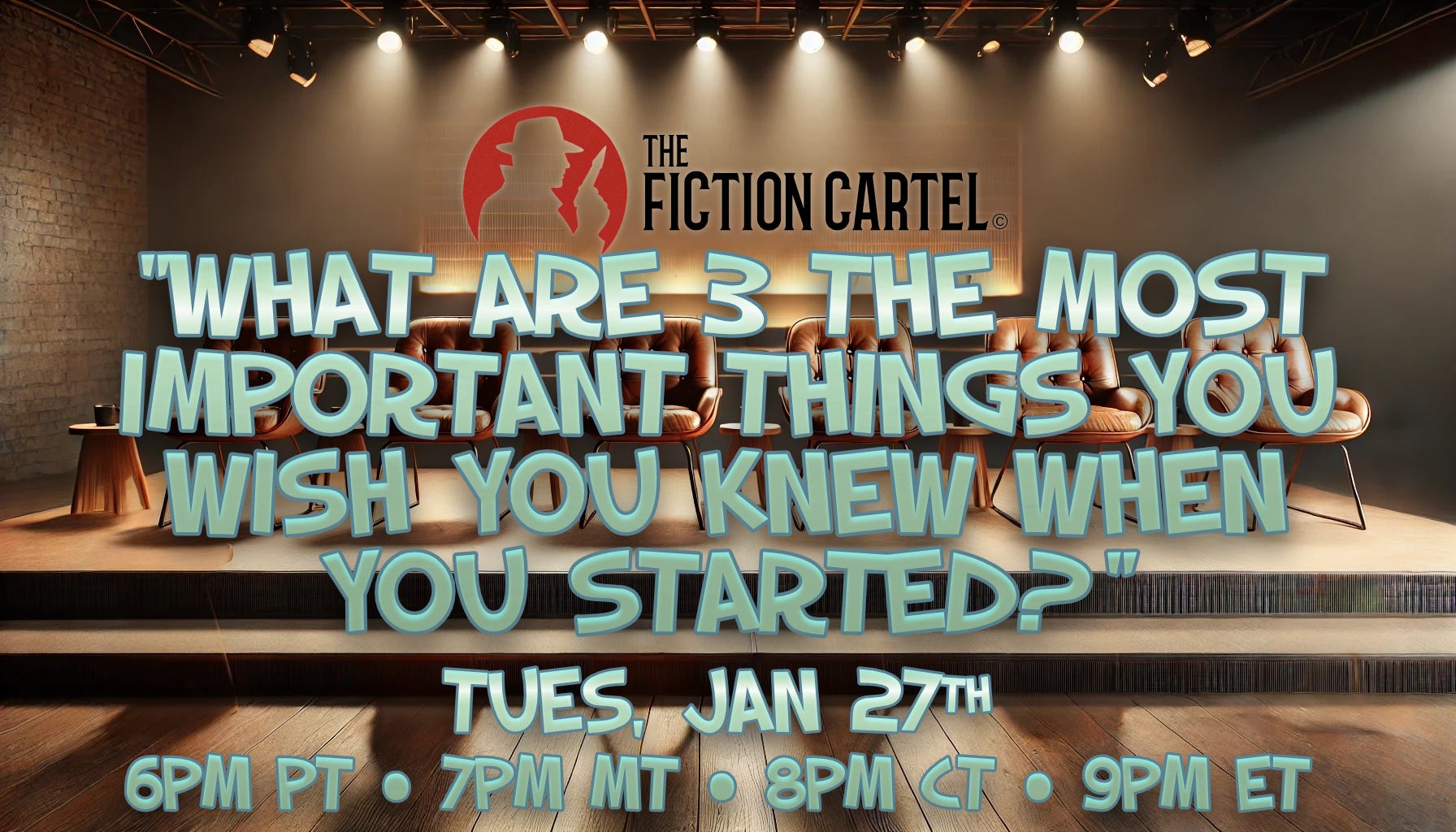
What Do YOU Want To Know?
Do you have questions you’d like us to answer?
Do you have something else you want to know that The Fiction Cartel can discuss next time?
🧭 About The Fiction Cartel
A bold new idea where writers come together live to talk craft, challenge conventions, and grow as creators. No scripts. No filters. Just raw, real writing minds sharing insights.
➡️ Want to join live next time? The link is ALWAYS THE SAME =)
Pull up a virtual chair at: https://gobrunch.com/fictioncartel
Hope you enjoyed the video. Drop a comment below and let me know!
Have a great day. Have a great week!
Remember:
You are MORE than you THINK you are!
Until Next Time,
Jaime *the-creative-addict* Buckley


