


Previously in Ink & Purpose…
In The Sacred Ordinary, we honored the courage it takes to simply stay—to keep showing up even when no one is clapping, and when the journey feels heavier than the strength we have left.
Today, we lift our eyes to something even larger: awe—the sacred spark that humbles us, connects us, and calls us to action. Wonder doesn’t just move us... it transforms us.

🌌 That Moment You Can’t Explain
I remember standing on a mountainside once—high above the tree line, where the wind whistles secrets, and the clouds press their palms against your face like some kind of blessing.
There was snow.
Silence.
Sky.
Nothing flashy.
Just light catching on untouched white.
The kind of light that makes you feel like the world is older, deeper, and somehow… aware that you’re standing in it.
I stopped walking.
Stopped breathing, I think.
Because everything in me went still.
And in that moment, something shifted.
Not a voice. Not a vision. Just this unspoken knowing:
I am small… and this is sacred.
It wasn’t fear.
It was awe.
That trembling, beautiful sense that you’re standing inside something bigger than you.
That you’ve brushed up against mystery.
And it saw you back.
I’ve felt it in nature.
I’ve felt it in music.
And more than once—I’ve felt it in fiction.
Reading a sentence that cracked something open in my chest.
Watching a character do something so selfless it hurt.
Reaching the end of a story and realizing—I wasn’t the same person I was when I started it.
Awe doesn’t just stun us.
It changes us.
It wakes us up to beauty.
To truth.
To pain that isn’t ours—and to people we’ve never met.
It makes us want to be better.
So here’s a question I’ve been sitting with lately:
What if awe isn’t decoration… but a doorway to heroism?
What if that sense of wonder is where courage begins?
Because maybe before we can choose to stand up for others—
We have to first remember that we’re part of something worth standing for.
🧠 Awe and the Brain – The Science of Transformation
Awe isn’t just a feeling—it’s a neural event that reshapes how we see ourselves and the world.
When we encounter something vast—like a star-filled sky, a powerful story, or an act of profound kindness—our brain responds in remarkable ways.
🧠 The Default Mode Network (DMN) and Self-Transcendence
The Default Mode Network (DMN) is one of the most active regions of the brain when we’re not focused on the outside world. It’s the part of us that lights up when we’re reflecting on ourselves—our plans, regrets, status, anxieties, or what others think of us.
In many ways, the DMN is the “me center” of the mind.
It’s where our inner narrator lives—the constant hum of “What does this mean for me?”
But something remarkable happens when we experience awe.
Whether you’re standing at the edge of the Grand Canyon, hearing a piece of music that moves you to tears, or watching a character in a story do something unspeakably kind or brave…
Your DMN goes quiet.
Instead of being absorbed in yourself, awe deactivates the DMN and activates regions associated with external attention, spatial awareness, and emotional regulation.
In plain terms:
Awe pulls us out of ourselves—so we can connect to something beyond ourselves.
This is why people often describe moments of awe with phrases like:
“I felt so small—but in a good way.”
“Time stopped.”
“I forgot about myself completely.”
It’s not about erasing who we are.
It’s about expanding the lens.
Feeling deeply part of something vast… and meaningful.
🔍 Supporting Research:
“Awe, the Small Self, and Prosocial Behavior” – Piff et al. (2015)
This study demonstrates that awe reduces self-focus and increases willingness to help others.
📖 https://pubmed.ncbi.nlm.nih.gov/25984788/“Neural Correlates of the Awe Experience” – Takano & Nomura (2019)
Researchers used fMRI to show that awe decreases DMN activity while increasing external awareness and social cognition.
📖 https://www.ncbi.nlm.nih.gov/pmc/articles/PMC6766853/Greater Good Science Center – “The Science of Awe” White Paper (Keltner & Haidt)
Explores the mechanisms and benefits of awe, including its ability to shrink the ego and open the heart to prosocial impulses.
📖 https://ggsc.berkeley.edu/images/uploads/GGSC-JTF_White_Paper-Awe_FINAL.pdf“The Neuroscience and Health Benefits of Awe and Wonder” – Nuvance Health
Outlines how awe calms the nervous system and improves cognitive and emotional well-being.
📖 https://www.nuvancehealth.org/health-tips-and-news/the-neuroscience-and-health-benefits-of-awe-and-wonder
🌌 The “Small Self” and Prosocial Behavior
In the moment of awe—when we’re faced with something vast, beautiful, or deeply moving—something shifts inside us.
Psychologists Dacher Keltner and Jonathan Haidt, both pioneers in the study of awe, describe it like this:
Awe arises when we encounter something so vast that it challenges our understanding of the world—something that forces us to accommodate our mental framework.
This isn’t just about seeing something “cool” or impressive.
It’s about being humbled in the best possible way.
That’s where the “small self” phenomenon comes in.
Rather than boosting the ego, awe does the opposite.
It shrinks the self-focus of the mind.
And in that shrinking, we actually grow.
We become:
More aware of others
More empathetic to those around us
More inclined to act with kindness, generosity, and moral courage
In fact, multiple studies show that people who experience awe are significantly more likely to:
Help a stranger
Donate money or time
Cooperate in group settings
Make ethical decisions, even at personal cost
Why?
Because awe relocates us in the story.
It reminds us we’re part of something larger.
It reminds us we belong to each other.
Fiction taps into this same psychological mechanism.
When a young reader walks beside a hero through struggle or sacrifice, awe isn't just felt—it’s internalized. And it’s that wonder—at bravery, beauty, or heartbreak—that makes them want to rise themselves.
Awe is not passive.
It leads to action.
🔍 Supporting Research:
Piff, Paul K. et al. (2015) – “Awe, the Small Self, and Prosocial Behavior”
This landmark study shows that awe reduces focus on the self and increases helping behavior.
📖 https://pubmed.ncbi.nlm.nih.gov/25984788/Keltner, D., & Haidt, J. (2003) – “Approaching awe, a moral, spiritual, and aesthetic emotion”
Foundational paper on awe as a transformative social emotion.
📖 https://www.researchgate.net/publication/10626707_Approaching_Awe_A_Moral_Spiritual_and_Aesthetic_EmotionGreater Good Science Center – White Paper on Awe
Summarizes dozens of awe-related studies, including the “small self” effect and its influence on cooperation and kindness.
📖 https://ggsc.berkeley.edu/images/uploads/GGSC-JTF_White_Paper-Awe_FINAL.pdf“The Science of Awe” – National Geographic Article by Amanda Ripley
A digestible breakdown of the psychological and social effects of awe.
📖 https://www.nationalgeographic.com/magazine/article/how-awe-drives-human-behavior-feature
🧬 Awe’s Impact on Health and Well-being
Awe isn’t just good for the soul—it’s medicine for the mind and body.
Experiencing awe has been shown to trigger a cascade of positive physiological responses. In fact, researchers now recognize awe as one of the most health-enhancing emotions we can experience.
When we encounter awe, the body releases endorphins, oxytocin, and dopamine—the very same neurochemicals associated with joy, connection, and emotional bonding.
But here’s where it gets even more fascinating:
Awe also reduces levels of cortisol, the hormone most commonly associated with stress, anxiety, and inflammation.
That means moments of wonder—whether from nature, music, story, or sacred silence—can literally:
Lower blood pressure
Improve heart rate variability
Strengthen the immune system
Reduce chronic inflammation
Support long-term mental clarity
🧘♂️ Awe as a Neural Reset Button
Studies using EEG and fMRI imaging have shown that awe dampens overactive stress patterns in the brain, while lighting up areas associated with creativity, problem-solving, and reflective thought.
This emotional "reset" allows us to step outside our survival mode and reconnect to higher-order thinking, imagination, and moral reasoning.
And this is exactly why fiction is such a powerful delivery system for awe.
A single passage.
A moment of sacrifice.
A sunset described so vividly it catches in your throat…
These moments slow the world down just enough for healing to begin.
Not as escape.
But as restoration.
Awe quiets the noise—so we can hear what actually matters.
🔍 Supporting Research (with full URLs):
Stellar, Jennifer E. et al. – “Positive Affect and Markers of Inflammation” (2015)
Found that experiences of awe were linked with lower levels of proinflammatory cytokines.
📖 https://pubmed.ncbi.nlm.nih.gov/26035037/Haidt, Jonathan – “Elevation and Awe: Evoked by Beauty, Sustained by Meaning” (2013)
Explores awe’s connection to well-being and moral elevation.
📖 https://www.researchgate.net/publication/259458066_Elevation_and_Awe_Evoked_by_Beauty_Sustained_by_MeaningKeltner, Dacher – Greater Good Science Center – “The Science of Awe”
Summarizes empirical evidence on how awe contributes to health, prosociality, and perspective shifts.
📖 https://ggsc.berkeley.edu/images/uploads/GGSC-JTF_White_Paper-Awe_FINAL.pdf“The Neuroscience and Health Benefits of Awe and Wonder” – Nuvance Health (2022)
Popular summary of medical and psychological benefits of awe.
📖 https://www.nuvancehealth.org/health-tips-and-news/the-neuroscience-and-health-benefits-of-awe-and-wonder

❤️ Moral Imagination and the Hero’s Heart
Before any heroic act… there is a moment of vision.
Not action.
Not instinct.
But imagination.
Someone has to see the possibility of doing good—
before they can choose it.
And awe is the emotion that cracks that door open.
When we experience awe—whether through a story, a piece of art, a stranger’s sacrifice, or the vastness of nature—it stretches our internal landscape. It lifts our chin.
Suddenly, we’re not just thinking about ourselves.
We’re thinking about something bigger.
About what’s right.
About who we might become.
That’s moral imagination.
The ability to picture an action that serves someone other than ourselves—
and believe we could step into it.
🧠 According to developmental psychologists, moral imagination is foundational to prosocial behavior and empathy.
It’s the ability to mentally simulate:
Standing up for someone else
Speaking truth at a cost
Showing kindness in the face of cruelty
Forgiving what feels unforgivable
This ability doesn’t come out of nowhere.
It must be formed. Exercised. Fed.
And that’s where fiction comes in.
Fiction is not just entertainment.
It is a training ground for the soul.
When we read about characters who suffer… who choose mercy… who love through loss… we’re not just watching. We’re rehearsing.
We’re walking those roads in our minds—laying the neural groundwork for what we might choose when the moment comes.
Because sometimes the only thing standing between someone and a heroic act…
is whether they’ve imagined it before.
Think of the first time you read about someone choosing sacrifice over safety.
Or the first time a character laid down power for love.
That awe you felt? That tightness in your chest?
That was your heart training itself to care deeply.
To act boldly.
To choose right when the stakes are real.
And that’s why children need stories more than ever.
Not just to escape…
But to practice.
They need to see flawed people rise.
They need to feel the weight of a hard decision.
They need to walk with characters who choose the hard road—and survive it.
Because someday, they may stand at a crossroads themselves.
And when they do…
Their imagination might be the only thing that tells them:
“You’ve been here before. And you can do this.”
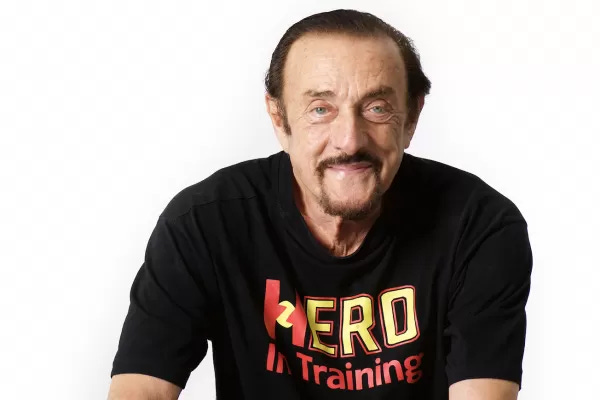
🦸♂️ Zimbardo’s Shift: From Evil to Heroic Imagination
In 1971, psychologist Dr. Philip Zimbardo conducted what would become one of the most controversial and eye-opening behavioral studies of all time:
the Stanford Prison Experiment.
It showed how easily ordinary people could commit harmful acts when placed in positions of power—how quickly we adapt to the roles we’re given.
Zimbardo’s takeaway?
“The line between good and evil is permeable, and almost anyone can be induced to cross it when pressured by situational forces.”
— Dr. Philip Zimbardo, The Lucifer Effect
That insight was sobering. But Zimbardo didn’t stop there.
Years later, he chose to pivot.
Not away from darkness—but through it… and toward the light.
Zimbardo founded the Heroic Imagination Project (HIP)—a nonprofit dedicated to teaching people how to resist destructive influence, develop moral courage, and practice everyday heroism.
His message became clear:
Heroism is not the domain of the extraordinary. It is teachable, trainable—and already inside us.
In his TED Talk, “The Psychology of Evil,” Zimbardo explores how systems, environments, and culture can lead good people astray. But by flipping that same lens, he points out:
If ordinary people can be seduced into harm… then ordinary people can also be guided into heroism.
It all comes down to preparation.
To story.
To imagination.
Because when someone sees themselves as a potential hero, they’re more likely to act courageously in real life.
This is where awe and fiction play a powerful role.
They create the emotional scripts that help someone imagine standing up, speaking out, or stepping in—before the moment of need arrives.
The Heroic Imagination Project doesn’t ask people to become legends.
It asks them to rehearse their courage in advance.
To live with eyes open, hearts engaged, and the will to act when it matters most.
📚 Want to go deeper?
Here are direct links to the source materials referenced in this section:
TED Talk – Philip Zimbardo: The Psychology of Evil
https://www.ted.com/talks/philip_zimbardo_the_psychology_of_evilHeroic Imagination Project – Official Website
https://www.heroicimagination.orgZimbardo’s Biography & Mission on TED
https://www.ted.com/speakers/philip_zimbardoWikipedia Overview of HIP (for general readers)
https://en.wikipedia.org/wiki/Heroic_Imagination_ProjectQuote Source – Goodreads: Philip Zimbardo on Evil & Choice
https://www.goodreads.com/author/quotes/124526.Philip_G_Zimbardo
📖 Stories That Breathe Wonder into the Bones
Some moments in fiction don’t just move you.
They mark you.
They sit in your chest like a candle lit years ago—still flickering.
Still whispering something true.
I remember reading the scene in The Hobbit where Bilbo, small and shivering, chooses to spare Gollum’s life instead of killing him.
Tolkien didn’t paint it as a triumphant moment. It was quiet.
But it was filled with something heavy and holy:
Mercy.
Compassion.
A choice that changed everything.
That was awe.
Not at dragons or treasure—but at the power of a single, human decision to be better than expected.
These are the moments fiction gives us:
Encounters with wonder that alter the course of the story—and the reader’s soul.
When Lucy steps through the wardrobe for the first time and feels the snow crunch under her boots.
When Ender realizes he’s destroyed an entire race—and the weight of it turns him from soldier to seeker of redemption.
When Wilbur the pig sees the word “SOME PIG” above his head and realizes he is loved.
When Harry stands between Voldemort and a friend—without a spell left in him—but still chooses to stand.
These scenes aren’t just good writing.
They are emotional blueprints.
They show us what courage looks like,
what sacrifice sounds like,
what wonder feels like when it matters most.
And that’s why young readers need these moments—desperately.
Because the world is loud.
It’s cynical.
It’s fast and hard and filled with pressure to be clever, ironic, detached.
But awe… awe breaks through that.
It softens the shell.
It gives them space to feel again.
When a reader encounters wonder through a character’s eyes, they’re not just observing—they’re becoming.
They’re practicing:
Reverence
Empathy
Emotional risk
The courage to believe something might still be good
These are the seeds that grow into action later.
Because before a kid decides to do something brave…
They have to see that bravery is possible.
Before they stand up to injustice,
before they forgive someone who hurt them,
before they choose compassion over cruelty…
They need a story that shows them it can be done.
Fiction isn’t just a mirror.
It’s a map.
And the moments that breathe wonder into our bones?
Those are the landmarks we carry with us for life.
Not because the story was real—
But because what it woke up inside us… was.

🌍 Stories Are Being Used to Grow Heroes
This isn’t theory anymore.
This isn’t abstract.
There are people—right now—who are using stories to build heroes.
To turn awe into action. Wonder into willpower.
And one of those people is Matt Langdon.
Matt worked closely with Dr. Philip Zimbardo and helped develop the Heroic Imagination Project into a global movement. But he didn’t stop there.
He founded The Hero Construction Company and later, The Hero Round Table—a global summit where educators, psychologists, scientists, artists, and everyday people come together to answer one question:
How do we raise more heroes?
And you know what they keep coming back to?
Story.
Not lectures.
Not punishments.
Not fear-based obedience.
But narrative.
Because narrative bypasses resistance.
It doesn’t just teach—it transforms.
The best programs in the world—like HIP and The Hero Round Table—use stories to:
Build ethical frameworks in youth
Help them imagine moral courage before the moment of testing
Normalize heroic thinking as ordinary, accessible, and necessary
In Matt’s words:
“Heroism isn’t something we’re born with—it’s something we rehearse.”
And what’s one of the best rehearsal spaces?
Fiction.
📚 Want to learn more?
Here are links to Matt Langdon’s work and initiatives:
Matt Langdon – Practice Makes Perfect .. Heroes
The Hero Round Table – Global Conference Site
The Hero Construction Company – How To Be A Hero
Heroic Imagination Project (HIP) – Where Matt helped build the foundation
https://www.heroicimagination.org/
If awe is the spark, stories are the torch.
And through people like Matt Langdon and Zimbardo’s legacy, those torches are being passed—into classrooms, communities, and hearts around the world.
Because when a kid reads a story that makes them feel awe...
they just might become the kind of person who answers a call to act.
🔚 Final Thoughts – Awe Is an Invitation
Awe humbles us.
It reminds us that we’re not the center of the universe—
that there are truths, beauties, and sorrows far bigger than we are.
But awe doesn’t shrink us.
It awakens us.
It opens our eyes… and gives us new ones.
The kind that don’t just see the world, but see what it could be.
The kind that don’t just feel moved, but start moving.
Because the real gift of awe isn’t a moment of wonder.
It’s vision.
A new way of looking at strangers.
At pain.
At injustice.
At the small flickers of courage in the mirror.
Awe doesn’t paralyze.
It calls.
It says:
“What you just felt? That sense that something matters more than you?
That’s the place your courage will rise from.”
And that’s the invitation:
Not just to notice beauty…
but to carry it.
Not just to admire the brave…
but to train your own heart to follow.
Because the world doesn’t need more admirers of goodness.
It needs more people who will answer awe with action.
✅ Call to Action: Light the Spark That Lingers
✨ Share this with someone whose soul still pauses at sunsets.
Someone who cries at stories, or stares out the window because their mind is off building something beautiful.
They haven’t outgrown wonder—they’re shaped by it.
💬 Reflect with me:
When did awe first change your direction? Was it a story? A moment in nature? A person who made you believe more was possible?
What fiction first made you whisper, “I want to be like that”... and meant it?
How can we help the next generation not just feel awe—but act from it?
📚 Let’s raise a generation of readers whose wonder turns into courage.
Because awe is not an escape—it’s the beginning of becoming.
You are MORE than you THINK you are.
— Jaime
NEXT TIME: The Stories We Tell Aren’t Harmless. Sometimes, They’re Everything.
THANK YOU: For reading why I do what I do.
If you’ve missed the series, here are the Why Fiction Matters links:
🌌 What If Wonder Is the Missing Ingredient in Every Great Story?
✨ The Stories We Tell Aren’t Harmless. Sometimes, They’re Everything.

If your looking for wonder have you ever checked out Jeff Vandermeer’s Wonder book?