


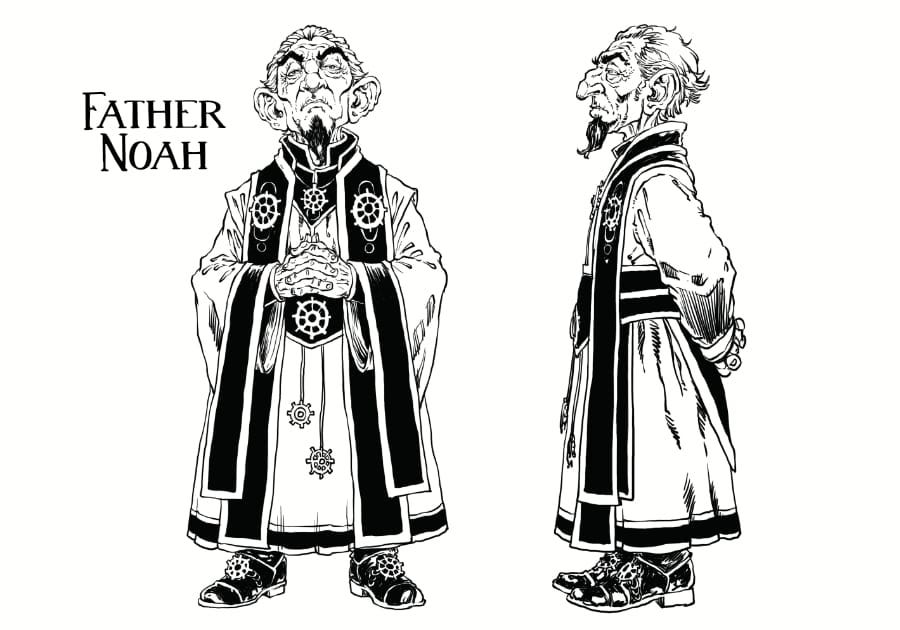
There are some people who walk into a room and demand attention.
Brother Noah (now known as ‘Father’ Noah) isn’t one of them.
That’s part of what makes him dangerous.
The first thing most notice about the elderly gnome is how ordinary he appears. Thin shoulders beneath layered robes. Calm eyes. Slow movements. A measured voice that rarely rises in anger. He speaks like a patient grandfather or a weary scholar who has spent too many years carrying the burdens of lesser minds.
And perhaps that’s exactly how he wants to be seen.
In the underground reaches of Clockwork City, Father Noah…also called Brother Noah among the faithful…is the powerful head of the Church of TGII. To the public, he is viewed as a spiritual guide, an orator, and a stabilizing force among a fractured people struggling to survive in the shadows of a larger world.
But in Chronicles of a Hero, appearances are often the first lie.
The deeper one digs into the world of the gnomes, the more complicated Father Noah becomes. He is not a cackling villain hiding in darkness. He does not storm battlefields with flaming swords or command armies through fear alone.
Noah’s power comes from something far more subtle.
Reminding others of laws or traditions, teaching the deep working of ancient scrolls and long-lost prophecies, Noah shapes perception itself.
He understands people.
More specifically, he understands weakness. Fear. Dependency. The longing people have to be told what to believe and what choices to make. Where some leaders inspire freedom, Noah inspires obedience. He wraps authority in scripture, ritual, and certainty until questioning him feels almost…sinful.
Those around him often mistake intelligence for wisdom.
Father Noah is highly educated in scripture, prophecy, church law, and the historical fears of the gnome people. He knows how to speak carefully…how to threaten without sounding threatening. He can comfort a grieving mother while quietly manipulating political outcomes behind closed doors. He can preach mercy publicly while crushing opposition privately beneath the machinery of doctrine and guilt.
And perhaps the most unsettling thing about him?
He genuinely believes most people are incapable of governing themselves.
Somewhere along the path of faith and leadership, Noah stopped seeing the people around him as souls to shepherd and began seeing them as resources to organize.
Pieces to move.
Crowds to steer.
Problems to contain.
That corruption did not happen overnight.
Like many dangerous men, Father Noah likely began with conviction. But conviction hardened into superiority. Superiority became contempt. Contempt became manipulation. And manipulation eventually became power.
The Church itself sits in constant tension with the governmental powers of the gnomes, each faction struggling for influence and control over Clockwork City. Noah understands this political battlefield intimately.
He knows alliances matter.
Fear matters.
Public image matters.
Truth?
Truth is negotiable.
Especially when prophecy enters the conversation.
One of the most important prophetic figures in Chronicles of a Hero is the Gnolaum. A promised individual tied deeply to the future of the gnome people. Rumors of the Gnolaum threaten established power because prophecy has a dangerous habit of awakening hope.
And hope is difficult to control.
This is where you may see Father Noah’s intent beneath the polished exterior.
Because if the prophecies are real…
If the hero truly exists…
If the gnome people are destined for something greater than the fearful existence they have accepted…
Then Noah’s authority may be questioned.
From the view of this gnome historian, I think that possibility unnerves him. Not because he openly serves evil, but because he cannot tolerate losing control over the world he spent decades shaping. Every rumor, every whisper, every ancient prophecy must pass through filters he controls.
Interpretations become weapons.
Doubt becomes policy.
Faith becomes leverage.
Father Noah is not evil because he enjoys destruction.
He is evil because he has convinced himself that some lives matter less than others.
That some sacrifices are acceptable.
That control is preferable to uncertainty.
And history…both fictional and real…is filled with gnomes who believed the same thing.
If you wait, and watch,…and look closely enough…you may see something.
The corruption of institutions, authority,…and moral certainty unchecked by compassion.
Because eventually, every tree bears fruit.
And over time, Father Noah’s fruit may reveal exactly what kind of gnome he truly is.
-Höbin