


Made with AI trained only on my own artwork. The honest story of how, and why →
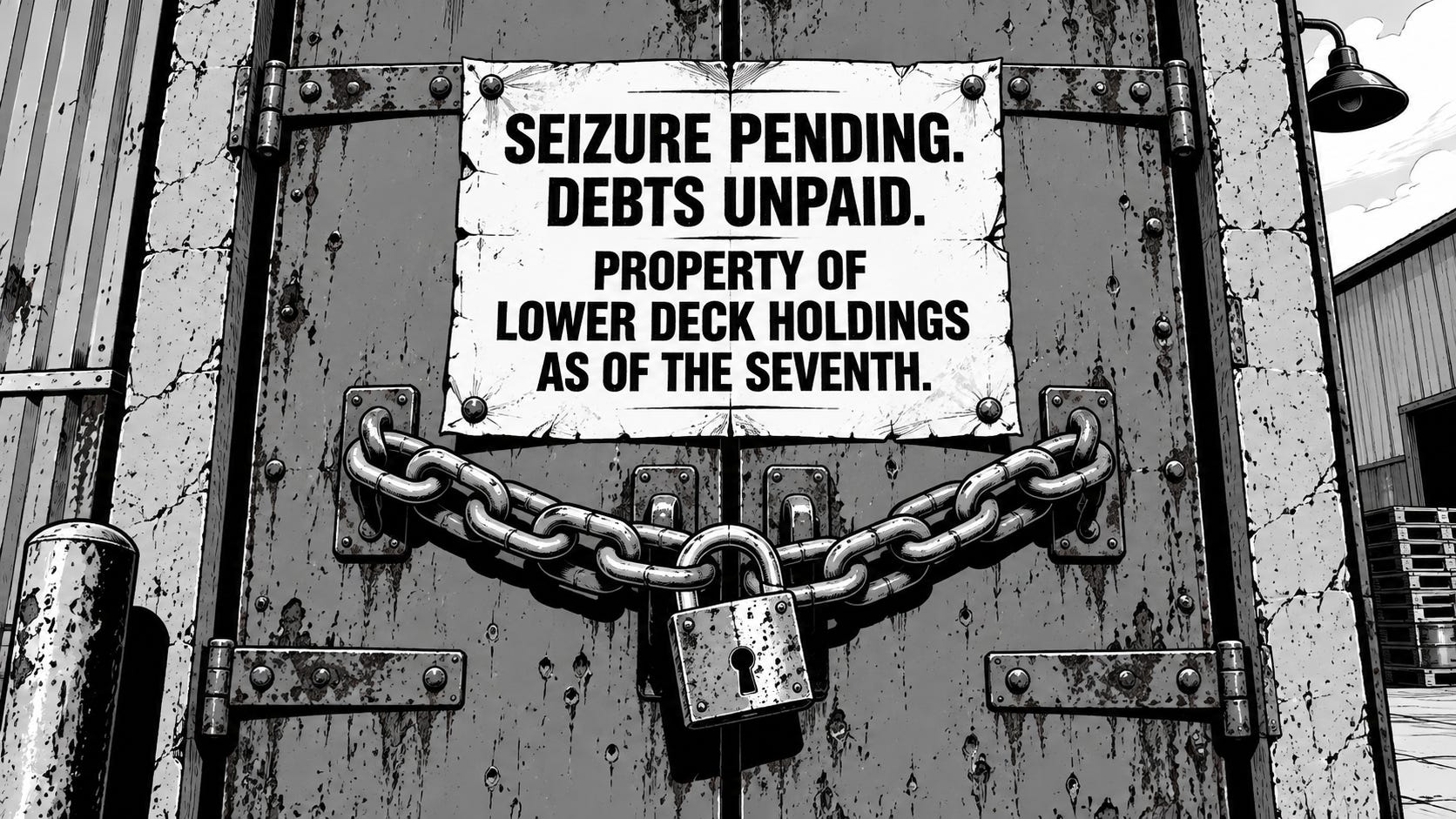
The notice on the garage door gave the Trench brothers six days.
Ernie felt that was generous of the city, all things considered, ...since it also would have been perfectly within its rights to give them none.
SEIZURE PENDING. DEBTS UNPAID. PROPERTY OF LOWER DECK HOLDINGS AS OF THE SEVENTH.
“Six days,” Burton said, reading it over his brother’s shoulder for the third time.
“I can count, Burton.”
“I know you can count. I’m saying it out loud because saying it out loud is worse, and I wanted to feel worse before I felt anything useful.”
Their father had built this garage with his own two hands, forty years back, on a scrap of Lower Slum nobody upstairs had wanted. He’d run it clean and honest right up until the year it killed him, slowly. Honest work in the Lower Slums tended to do that. He’d left them the tools and the building.
Unfortunately, he’d also left the boys a debt he’d been too proud to mention.
Deck Holdings had mentioned it plenty, since.
“We need coin,” Ernie said. “A lot of it. By the seventh.”
“We have four gears, a busted forge, and each other.”
“That’s not nothing.”
“It’s also not a lot of coin, Ernie.”
Ernie looked past his brother, out the cracked garage window. He could see up through the scaffolding and the smoke and the four decks of Clockworks City stacked overhead. It looked like a cake nobody had bothered to level, all the way to the glittering underside of the Upper Decks. That was where the kind of people lived who had never once read a seizure notice with their own name on it.
“There’s the Chute Run this Friday,” he said. “Prize purse is the biggest it’s been in three years. Word is Deck Holdings themselves are backing half the book on it.”
Burton went very still. The specific way he went still whenever his brother was about to say something that would eventually involve prison, an infirmary, or both.
“No,” he said.
“You haven’t heard the idea yet.”
“I don’t need to hear the idea. I’ve known you nineteen years. I can hear ideas coming the way other gnomes smell rain.”
The Chute Run had been racing through the old freight tunnels under Clockworks City longer than either brother had been alive. It was an entire vertical network of drained supply chutes built to move cargo between decks. That was back before the decks stopped speaking to each other civilly.
Nobody used them for cargo anymore.
Everybody with more ambition than sense used them to race homemade sleds down four levels of near-vertical drop. They did it for coin, for bragging rights, for the particular kind of fame available only to gnomes willing to risk their necks.
In front of a paying crowd, of course.
It was, by any sane measure, illegal, unregulated, and a terrible idea.
Ernie had been building sleds for it since he was twelve.
“I’ve got a design,” he said, spreading a grease-stained schematic across the workbench, “that nobody’s tried. Everybody runs the chutes on gravity and nerve. What if we don’t.”
Burton leaned over the schematic, squinting.
“That’s a steam thruster.”
“That’s a steam thruster.”
“Bolted to the back of a sled that’s already going to be falling four decks at a speed no sled’s built to survive.”
“Correct.”
“Why.”
“Because gravity gets you to the bottom of the Run in a straight line,” Ernie said, “and a straight line loses every time to the crew who can cut the third-deck switchback without slowing down for it. Nobody cuts that switchback. Everybody’s too scared of the wall.”
“There’s a wall there because the last four gnomes who didn’t slow down for it hit it.”
“This,” Ernie said, tapping the schematic, “is how we don’t hit it.”
Burton stared at the drawing a long moment, the particular stare of a gnome doing math he didn’t want the answer to.
“I hate that it might work,” he said finally.
“I know.”
“I hate that I already know I’m the one riding it.”
“You’re lighter. And braver. And considerably better at not panicking when things are on fire.”
Burton stared at him.
“Which, statistically, is a real possibility here.”
“Comforting.”
“I try.”
——————
They built it in five days, sleeping in shifts, arguing over tolerances. They always argued, loudly, constantly, and without either of them ever once actually getting angry.
“The valve bleeds too fast,” Burton said, testing it Thursday night. “You give me full thrust for six seconds. I need at least eight to clear the switchback.”
“Eight seconds of full steam and that tank’s going to want to be somewhere else entirely.”
“So build it a bigger tank.”
“There’s no room for a bigger tank without moving the seat, and if I move the seat, your knees come up through the housing on the first drop.”
“Then I’ll ride with bad knees.”
“You’ll ride with no knees.”
They compromised, the way they always compromised. They built something slightly too ambitious for either brother’s comfort, then called it settled at two in the morning out of sheer exhaustion.
Ernie would run the ignition and trim controls from a strapped rig on his own chest. It would be wired down the chute to Burton’s sled by a thin copper feed. It would be the same way he’d wire nearly everything for the rest of his life.
...once he learned the trick worked at all.
“If I lose the signal,” Ernie said, “you’re on your own for the thrust cutoff.”
“Wonderful.”
“I won’t lose the signal.”
“You’ve never once tested this at full drop speed.”
“No,” Ernie admitted. “I haven’t.”
——————
Friday night, four decks up, the crowd for the Chute Run packed in tight along the safety rails with money already changing hands. Burton dropped into the number six chute with his brother’s copper feed taped along his spine. His heart pounded harder than he’d ever admit to.
The first two decks went clean. Gravity, mostly, same as everyone.
The switchback came up on deck three exactly where Ernie’s numbers said it would. Ernie fed the thrust in at exactly six seconds, precisely as planned. For about a second and a half, it was the single greatest thing either brother had ever built.
Burton cleared the switchback nobody cleared.
Then the valve, exactly as Burton had warned it might, bled its charge two seconds faster than the schematic promised. The sled came out of the thrust not slowing into deck four the way it was meant to. Still climbing speed, still angled hard from the turn, aimed at a wall that was absolutely not the finish line.
It was, in fact, aimed at the private freight spur belonging to a rich merchant named Hazlitt. It was sealed, restricted, and guarded by precisely the kind of gate that gets built specifically to keep gnomes like Burton Trench out of it.
Burton went through that gate.
...at a speed no gate is built to survive.
——————
“How did he do,” Ernie asked, three hours later, sitting on an overturned crate in a Deck Holdings holding cell.
Burton looked at him for a long moment, soot-streaked, one boot missing, entirely alive.
“Well,” Burton said, scratching his head, “we cleared the switchback.”
“And then.”
“And then I went through Hazlitt’s private gate at considerable velocity. I destroyed roughly one hundred feet of his personal rail spur. Then I landed in what I am fairly sure was his prize cellar.”
“Prize purse?”
“Forfeit. Racing outside the sanctioned course voids the entry, apparently. Something about liability.”
Ernie put his face in his hands.
“So we lost the money,” he said, “wrecked a merchant’s private rail, and are currently sitting in a cell that is very likely the first stop toward a much longer cell.”
“That’s about the shape of it, yeah.”
There was a long silence. The two sat in the dark, listening to Deck Holdings enforcers arguing in the corridor over which charge to file first.
“Was it worth it,” Ernie asked finally.
Burton considered this with the seriousness of a gnome who was very tired, very sore, and very impressed.
“We cleared a switchback nobody’s ever cleared,” he said. “In a sled we built ourselves, out of parts we couldn’t afford, powered by an idea everybody else in that crowd was too scared to try.”
“We’re also going to prison,” Ernie muttered.
“Also true,” Burton agreed. “Both things can be true, Ernie. That’s sort of been our whole life so far.”
Ernie laughed, despite everything. It was the short helpless kind of laugh that comes out when a gnome’s run clean out of better responses.
“Next time,” he said, “bigger tank.”
“Next time,” Burton said. Then he shook his head. “No next time, unless we’re the ones who own the whole track.”
Ernie looked over at him in the dark cell, something working behind his eyes. It had nothing to do with valves or tolerances.
“Now THAT,” he said slowly, “is actually a very good idea.”
“Don’t,” Burton said. “Not tonight. Let me be arrested in peace for one evening before you start building something new.”
But Ernie was already turning it over. Out loud, half to himself and half to the brother who’d never once, not on that sled and not in that cell, let him build anything alone.
They did their time.
It cost them the garage in the end. Same as it would have without the Run, which was its own bitter joke neither brother found funny for a long while.
But they came out the other side of it with one thing Deck Holdings could never repossess.
An idea about who ought to own the track.
It would take them the better part of twenty years to build it.
They built it anyway.
