


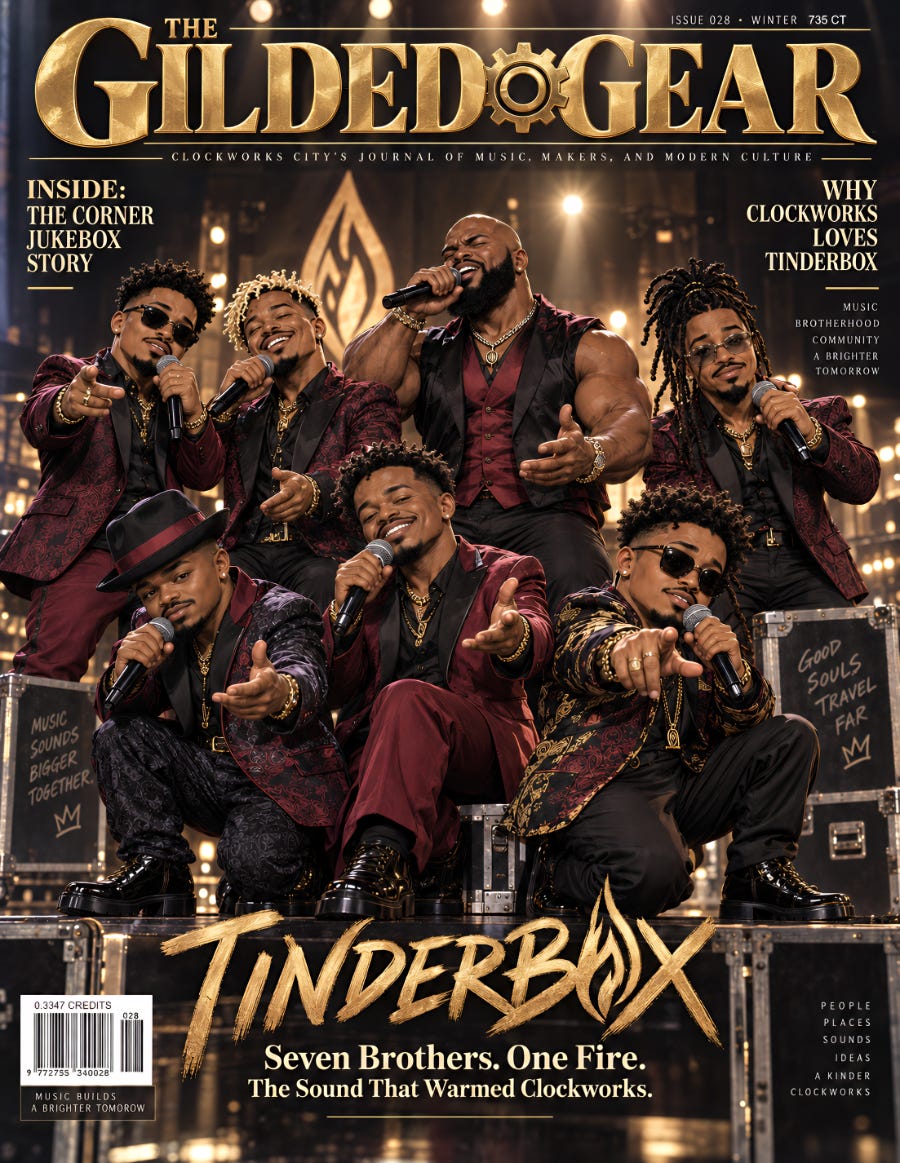
Listen to TINDERBOX’s #1 Hit: Mama, You Made Us
There are bands that become popular.
There are bands that become important.
And then there are bands that somehow become personal. When a whole city has privately decided, without meeting, that these musicians belong to all of us.
That’s TinderBox.
They did not arrive polished from a conservatory. They did not descend from the sky in velvet, smoke, and expensive machinery. They did not begin with patronage, endorsement, or a polished launch campaign crafted by clever men with silver cufflinks and no rhythm.
They began on a corner.
A real corner.
Manufacturing District. End of shift. Steam still hanging in the air. Boots scraping stone. Lunch tins clanking. Workers filing home with tired shoulders and louder thoughts than they wanted to carry.
And there, on that corner, stood seven brothers.
No proper stage. No grand mechanical accompaniment. No brass section. No harmonic amplifiers. No clockwork resonators.
Just voices.
Seven of them.
And for reasons nobody fully understood at the time, people stopped walking. That is how legends tend to begin. Not with trumpets. With interruption.
A tired machinist slowing down.
A welder staying five extra minutes.
A foreman pretending not to enjoy himself.
Somebody saying, “Sing that one again.”
By the time Clockworks gave them the nickname The Corner Jukebox, the city had already claimed them.
Listen to ‘The Corner Jukebox’…
Now, years later, TinderBox stands as one of the most beloved vocal groups in the city’s history, and perhaps the most gnomish.
That word matters.
Because for all their control, harmony, wit, timing, and stagecraft, TinderBox never sounds machine-perfect. Thank the stars for that. Clockworks has enough machines.
TinderBox sounds alive.
They interrupt each other. They grin through lines. They throw spoken asides into songs like sparks off a rail grinder. They tease. They mock. They laugh. They risk. They leave room. They know when to let a line land. They know when to pile six voices behind one moment and make the whole hall feel it in the chest.
And when all seven lock together, the effect is not “good harmony.”
It’s a force.
The Soot Street Singers:
“We were prepared to dislike them. Then they opened their mouths.”
THE BROTHERS AND THE FIRE
Part of TinderBox’s genius is that each brother is so distinct that he could become a caricature in lesser hands. Instead, each voice sharpens the whole.
Brick, the eldest, anchors the group with a bass voice so deep it feels less sung than constructed. He does not merely support harmony. He gives it weight, gravity, and moral authority. When Brick enters, songs stop wandering and start meaning something.
Kai is the stabilizer. Calm baritone. Dry wit. The brother most likely to say the thing everyone else should have realized five minutes earlier. His restraint is one of the band’s quiet superpowers.
Zay carries frontman energy without vanity. Smooth, charismatic, built to open songs and win rooms. He could easily dominate the group if TinderBox were built on ego. It is not. That is precisely why he works.
Rio brings brightness, lift, and speed. There is sunlight in his phrasing. He sounds like motion.
Drew is the emotional center. Warm, sincere, and devastating when given the right line. If TinderBox ever breaks your heart, odds are Drew held the hammer.
Snap is the troublemaker. Rapper, wit, rhythmic spark, and occasional accelerant. He pushes, pokes, jokes, and keeps the group from becoming too noble for its own good.
Jace, the youngest, is pure rhythmic invention. Part vocalist, part percussion section, part walking impulse-control problem. His beatbox work gives TinderBox its street pulse and modern drive.
Separately, they’re memorable.
Together, they’re a phenomenon.
The Tin Chapel Boys:
“They sing like brothers. This is either their greatest advantage or their most dangerous weapon.”
THE GREAT TRICK
Many bands can make you dance. Some bands can make you laugh. A few can even make you cry. Almost none can do all three in the same song without feeling manipulative, sentimental, or drunk.
TinderBox makes it the most natural thing in the world.
Take “Get Up and Dance.” It is exactly what the title promises. No pretension. No elaborate thesis. No philosophical disguise. It grabs the listener by the sleeve and says, in effect, “You’ve sat long enough. Your mood can walk itself out.”
Listen to “Get Up and Dance”
Then compare that to “Cool Dad.” On paper, the premise sounds almost dangerously sweet: a tribute to a father who was a cartoonist, fiction writer, gamer, game master, and sacrificial family man. In practice, it works because TinderBox understands something many writers do not.
Specificity is priceless.
They do not tell us he was wonderful. They show us ink on his fingers. Dice on the table. One more game before bed. A father clearing space in his schedule and life so his children could feel seen. By the time the emotional truth arrives, it has earned the right to stand.
That is craft.
And TinderBox has more of it than some of their skeptics care to admit.
The Brass Lanterns:
“Annoyingly excellent.”
NOT JUST NOVELTY
Lazy critics have, at times, tried to dismiss TinderBox as a novelty act. This is what happens when a city grows too proud of its own seriousness.
Yes, they are funny.
Yes, they have songs about workweeks, tabletop gaming, dancing, colonoscopies, and younger brothers being incapable of serenading a girl without six relatives interfering.
And yes, one of those songs is very likely better constructed than the earnest anthem written by whichever critic is sneering.
Humor is not the absence of art. Sometimes it is art with courage.
Comedy requires timing, trust, contrast, and control. TinderBox has all four. More importantly, they understand that the joke is never the destination. It is the doorway.
Their best songs do not simply entertain. They reveal.
“That Was Not the Plan” begins as a comic song about brothers destroying a tabletop campaign through stubbornness and chaos. By the end, it quietly admits that no one remembers the treasure anyway. They remember the table. They remember laughing. They remember each other.
That’s a worldview.
Listen to ‘That Was NOT the Plan’
Mainspring Mercy:
“We object to their tempo choices and also own all their records.”
THE CORNER, THE NAME, THE PURPOSE
If “The Corner Jukebox” is the band’s origin song, then “TinderBox” is its mission statement.
The name, as the brothers tell it, came not from a desire to sound dangerous or grand, but from a question: What do we want the music to do?
Not what do we want to sell. Not how famous do we want to be. Not how many halls do we want to fill.
What do we want the music to do?
The answer was simple enough to miss. They wanted people to leave warmer than they found them. That’s the band’s character in one sentence.
A tinderbox doesn’t create fire from nothing. It carries the spark until someone needs it.
There are more sophisticated artistic manifestos in Clockworks. There are certainly longer ones. There are ones written on embossed paper by musicians with nicer boots. After twenty years in this business I can’t believe I’m actually going to say this, but…
None are better.
THE VERDICT
TinderBox is not merely a great gnome vocal group.
They’re a cultural force precisely because they resist becoming a cold one. Tinderbox reminds Clockworks that excellence and affection are not enemies. That humor and depth can share a stage. That technical skill need not sterilize joy. That a room full of tired people can walk out lighter than they walked in.
And that seven brothers, standing on a corner after shift change, can still out-sing an empire of polished machinery if what they have is true enough.
Plenty of groups are admired.
TinderBox is loved.
Clockworks is better for it.
What Other Clockworks Bands Are Saying About TinderBox
Merrick Coil, lead singer of The Copper Saints
“They broke half the rules we spent twenty years learning. Then they made the audience love them for it. I object on professional grounds.”
Velka Rivet, frontwoman of Boilerheart
“Most groups try to sound bigger than they are. TinderBox sounds closer than they are. That is much harder. Also annoying.”
Orrin Spoke, arranger for The Geargrinders
“Those boys got paid in sandwiches, handshakes, and overtime applause. You cannot fake a beginning like that.”
Tessa Flint, vocalist of The Little Hammers
“They made brotherhood fashionable again. Messy, loyal, loud, funny, exasperating brotherhood. I respect it.”
Fenwick Bassel, frontman of The Winding Keys
“I heard ‘TinderBox’ once and cried into my tea. Print that and I will deny everything.”
Nib Clatterdock, rhythm captain of Smoke & Sprocket
“Jace beatboxed an entire train yard with his face. I have not recovered.”
Elsin Thread, lead harmonist of Velvet Ratchet
“Brick’s bass comes in like a moral consequence.”
Parn Loom, tenor of The Rivet Belles
“I came for the comedy. Then Drew hit one line in the bridge and I had to reconsider my entire emotional framework.”
Cobble Vane, founder of Five Below Street
“They became family first. Fame just followed.”
ADVERTISEMENT

ONE NIGHT ONLY
TINDERBOX LIVE AT THE CLOCKWORK GRAND HALL
SEVEN VOICES. ONE FAMILY. ONE FIRE.
From the streets of the Manufacturing District to the grandest stage in Clockworks, the band that turned street-corner soul into citywide legend returns for an unforgettable night of harmony, humor, heart, and impossible vocal fire.
Featuring:
The Corner Jukebox
Get Up and Dance
Cool Dad
That Was Not the Plan
Don’t Beatbox This Part
TinderBox
Plus audience favorites and live brotherly chaos
Doors: 6:30 bell
Show: 7:30 bell
Venue: The Clockwork Grand Hall, Copper Avenue
Tickets: Available at all authorized gear-post kiosks and hall box offices
Warning:
Attendance may result in laughter, dancing, emotional reflection, and strong opinions regarding your favorite brother.
TINDERBOX
Leave ’Em Warmer Than You Found ’Em
Press inquiries: WHRN Media Relations | lifeoffiction.com © Gnome-Tone Records™/ © Jaime D. Buckley. All rights reserved.