


Made with AI trained only on my own artwork. The honest story of how, and why →
The wheel was turning, and there was nobody to turn it.
I knew that sound the way you know your own heartbeat.
Forty years of it.
The long groan of the axle, the slap of the paddles taking the Ash, the deep stone hum underneath where the runner kisses the bed.
It was the middle of the night.
The mill was shut.
The key was under my pillow, where it had lived since I buried Tam.
And the wheel was turning.
I lay there and told myself it was the wind. The Ash was up from the spring melt, and a strong current can nudge a wheel a hand’s width and make it moan.
But a hand’s width does not grind grain.
I got up.
I am sixty-one years old and my knees announced every stair, but I went down them anyway.
...because a woman who owns a mill goes and sees about her mill.

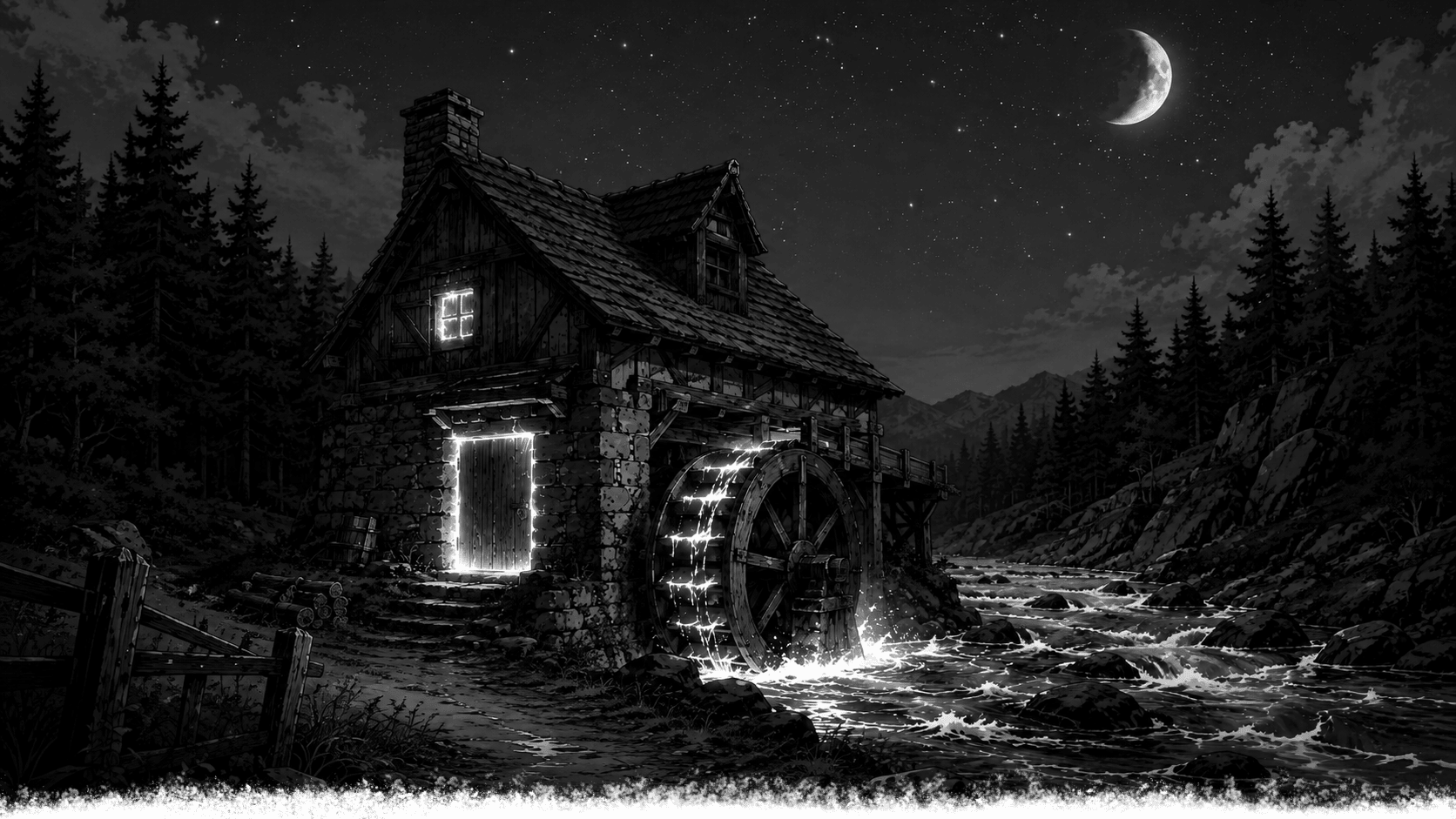
The night was cold and clean and full of stars, and my own mill sat there, in the dark, working like a Tuesday.
Light pushed from the cracks of the door.
Not lamplight.
It was that white river-shimmer that comes up off the wheel-house when the paddles throw water. The whole building breathing the way it does under load, warm and busy and mine.
I stood in the yard in my dead husband’s coat, with no earthly idea who was inside it.
I want to tell you I was brave.
What I mostly was, was annoyed.
Somebody was using my mill.
My good runner stone, that Tam dressed by hand twice a year with a pick worn down to a nub.
My grain, if it was my grain.
My river.
I put my hand on the door. It was unbarred from the *inside*.
Then the light went out.
All at once.
...and the wheel slowed, and slowed, and dragged itself to a stop with that little backward knock the pawl makes.
By the time I got the door open, the mill was empty.
Warm floury air. The bed still ticking as it cooled. A film of fresh meal on the stones, so fine it hung in the star-shine like breath.
And not a soul in it.
I am not a woman who runs to the reeve.
Godfry is a decent enough fellow and he means well, but he handles a mystery the way a dog handles a wasp...
With a great deal of noise and no improvement to anybody.
If I told him my mill ran itself at night, he would post a boy at my door. That boy would eat my bread and see nothing. The whole of Ashbrook would then know that the widow at the mill was hearing wheels in the dark.
So I did the **sensible** thing.
I counted my grain.
Tam kept the stores the old way, in bins along the north wall, each marked with a burnt letter. I have kept them the same, because grief makes you tidy...or it makes you a ruin.
I chose tidy.
...and I knew what was in every bin to the double-handful.
I was short.
Not robbed, mind you.
Robbed is a bin turned out and a mess left.
This was careful.
A measure gone from the barley. A measure from the winter wheat. From the *good* milling wheat.
The pale hard kernels the bakers pay for, a measure and a half.
Someone had taken grain from me the way you take a coin from a jar you mean to pay back.
That someone had ground it.
I stood there with the tally-stick in my hand and did the arithmetic.
The arithmetic said a thief.
A patient one, who knew mills, who could set a wheel and dress a load and sweep up after himself...then vanish before an old woman got down her own stairs.
I did not like the arithmetic.
Because the next morning, Bett Aldous came by for her quarter-sack.
...and she was **crying**.
It wasn’t the sad crying.
The *other* kind.
The kind that leaks out sideways when a person has been holding on with both hands and something finally lets them stop.
There’d been flour on her step. A full sack of it, good and fine, sitting against her door in the dark, like the morning left it there on its way past.
“I didn’t order it,” she said. “I couldn’t have paid for it. Merta, you know I couldn’t.”
I knew.
Bett lost her man to the coughing sickness two winters back. She has three little ones and a garden the size of a tablecloth. She has been grinding acorns and pride into the same porridge for a year.
When I “sell” her a quarter-sack, we both understand the ledger. Neither of us says so, because there are kindnesses you can only do if you agree to lie about them a little.
“It wasn’t me,” I told her.
And it wasn’t. I’d have known. My flour has a way of standing that another mill’s doesn’t, on account of how Tam set the stones. They’re close and slow, so it comes off cool. Fast milling scorches. You can taste the difference if your whole life has been flour, and mine has.
I took a pinch off Bett’s step and rubbed it between my fingers and put it to my tongue.
Cool.
Close and slow.
My stones.
My grain, gone in the night, come back as a sack on a widow’s doorstep.
There were more.
Once I knew to ask, I heard them all week, in that sideways Ashbrook way. Nobody announces a thing, but everybody has heard it.
A sack at the Pell house, where the father’s hand was crushed at the quarry and hasn’t closed right since. A sack at old Ren’s, who has outlived everyone who ever owed him anything. A half-sack, even, at the temple door, where the Sisters feed whoever kneels there at supper and never ask what god sent them.
Somebody was stealing from my mill at night and giving it to the people in Ashbrook who had the least.
Somebody was robbing me to feed my neighbors.
Part of me wanted to leave it alone.
The grain was mine to lose, and I was losing it to the exact people I’d have given it to if I could have done it without shaming them past bearing.
Whoever it was had found a way to do the thing I couldn’t.
He fed them and let them keep their faces.
A sack in the dark asks nobody to say thank you.
But it was my mill.
I couldn’t sleep for the sound of it, and a body has to know.
So I sat up.
Third night, I finally caught him, because I stopped being clever and started being patient. The only trick I have ever known that works.
I did not hide in the mill. He’d have heard me breathe.
I hid in the wheel-house, up on the little service ledge over the pit where Tam used to grease the axle. Wedged myself in the damp and the roar, with my knees screaming, and a lantern I did not light.
He came just past the middle of the night.
I heard the bar lift. Heard the sluice-gate go up, easy, by a hand that knew which board stuck. Heard the water take the wheel and the whole world I have lived in start to turn.
Then I climbed down into my own mill, cold and furious and afraid.
There in the meal-light, with his sleeves rolled and a sack held open under the spout, was Corley Fenn.
Corley.
Who cannot count past his fingers. Who Tam kept on for twenty years to haul sacks and mind the sluice, because Corley is strong as a wall and gentle as milk. The good Ashbrook folk called him simple the way they call the river wet.
I let him go, after Tam died.
It’d hurt me to do it, but I couldn’t pay him. Corley never said a hard word. Just touched his cap and walked off up the Ash.
I have felt the size of that ever since.
He saw me and his whole big face fell open like a dropped bowl.
“Merta,” he said. “I put it back. I always put it back. Not the flour, I can’t put the flour back, but I. I meant to tell you the numbers. I’m no good at the numbers.”
“Corley,” I said. “What in the world.”
And he told me.
It took a while.
Corley tells a thing the way the Ash takes the long way round the meadow. Luckily I have all the time a widow has, which is all of it.
A traveler had come through. Weeks back, before the thaw was full.
A young one, Corley said. Younger than he expected, for what he did. Passing along the river road with the look of a lad who’d walked a long way and meant to walk a lot farther.
And he’d stopped, because the mill was silent.
You have to understand what that means, in a mill town. A silent wheel in daylight is a wound everyone can hear. Mine had been silent because the pit-gear had thrown a tooth in the winter and seized. The wheelwright three towns down wanted more to fix it than I’d cleared all autumn.
So I had a mill I could not run and a town that had to cart its grain a day’s ride to Tildan and back.
...and pay for the privilege.
The boy had climbed down into the pit.
“He weren’t afraid of it,” Corley said, wonderstruck all over again. “Most folk are afraid of the pit. He got right down in the wet and he looked at the gear a long time. It was strange, him standing there, talking’ to himself. Then he nodded, and asked me for the pieces. I gave him the tooth I’d kept because I didn’t know what else to do with it, and he. Merta, I don’t know how he did it. He had a way. He warmed it or he sang at it or I don’t know. He set it. He set the gear that Nolan wanted six silver to set, and he did it for nothing, and when it turned he laughed like it was the finest thing he’d ever heard.”
I believe that part without any trouble.
There is no sound in the world like a dead wheel coming back.
“And then,” Corley said, and here he got shy, and turned the empty sack over in his big hands, “then he sat with me on the step and we ate, and he asked me who in the town was hungry. And I told him. I know who’s hungry. Folk think I don’t know things but I know that one.” He looked at me. “And he said, feed who you can, Corley. He said it like it was easy. Feed who you can and let the mill do it quiet, so nobody has to be ashamed. And then he went on up the road.”
“And you’ve been doing it,” I said. “Since the thaw. In the dark. So nobody’d be ashamed.”
“I put it back,” Corley said again, miserable. “The numbers.”
I did not have the heart to explain to Corley Fenn about the numbers.
That you cannot put ground grain back. That a measure of wheat made into a sack of flour on Bett Aldous’s step is gone from my bin forever and does not return, no matter how carefully you sweep.
He’d been putting the empty *sacks* back.
Folding them.
Squaring them on the shelf.
In his mind the ledger balanced because the sacks came home.
How do you look at a man who has been feeding your whole poor town out of your own stores for a season, and tell him he has done a sum wrong.
You don’t.
I put Corley back on.
I can’t afford him.
Did it anyway, and we will grind fine or we will grind each other.
...but I would rather do it with him than without.
And I have kept the night-milling.
Changed nothing but the bookkeeping, which is to say I now know it’s happening. I write it in a bin of its own, marked with a letter that isn’t a letter. If the mill comes up short at year’s end, then the mill comes up short...
Tam can argue with me about it when I see him.
Feed who you can. Let the mill do it quiet.
The boy was right. It was easy. It was the easiest thing I ever agreed to.
There was a song, for a while.
The mill-children made it.
There are always mill-children, the ones too small to be useful and too curious to be anywhere else. They’d caught the shape of the story the way children catch everything you’d rather they didn’t.
A boy who came out of nowhere and set the wheel right. Who fed the town and walked away.
They made him taller in the song. Gave him a sword he didn’t have and a cloak he didn’t have. We never knew his name, so they made one up. Changed depending on who sang it...back again through a dozen small mouths.
It was a silly song. It scanned badly. I loved it the way you love a thing that is entirely your own town’s and nobody else’s.
They sang it at the wheel. It went with the turning.
Then a man came, and it stopped.
I only met him the once.
A courteous fellow, in the kind of grey coat that doesn’t show the road.
He came to the mill in an afternoon and bought a sack he didn’t need. He just stood in my yard. admiring the wheel. Had a way of asking questions that didn’t feel like questions at all. Just a warm, unhurried interest, like the two of you had all day and nothing better.
I told him the story. The whole of it. Corley, the gear, the boy, the sacks in the dark.
I don’t know why I told him. I’m not a teller.
But he was so easy to talk to that the telling just... came out of me, the way meal comes off the stone. By the end I’d given him more than I’d given the reeve.
He paid me for the sack with an old coin. Andilain-struck, worn smooth as a river stone. A generation out of date at least. I remember thinking a man doesn’t carry a coin that old unless he’s carried it a long way.
“That’s a fine tale, mother,” he said. “One more time, if you’d humor me. Just the part about the boy and the wheel. For the pleasure of it.”
So I told it again. And he listened like it was the only thing in the world.
Then he went to the children.
I saw it from the step and thought nothing of it. A kind traveler, giving the little ones a coin each, and them delighted. It was only later I understood what he’d bought.
He’d asked them to sing him a different song.
Gave them each a bright coin and a smile and asked, so gently, wouldn’t they learn a proper one. A real one from a real city, instead of that scratchy little thing about the mill. And children being children, and a coin being a coin, they did.
They sing the new one now.
It’s a better song. It scans.
And the other one is gone.
I’ve tried to call it back. I stand at the wheel some nights while it grinds for the hungry, and I reach for the tune the way you reach for a name that was on your tongue a breath ago.
There’s nothing there.
Just the shape of where it was.
I remember that there was a song.
I can’t remember how it went.
I’ve turned it over a good deal, in the dark, with the stones humming.
Why a man would ride into a river town and pay good silver to buy a story off an old woman, and then pay again to take a song out of children’s mouths. Why anyone would want a kindness *forgotten.*
I don’t have it. I’m a miller, not a wise woman.
I grind what comes and I sweep up after.
But I’ll tell you the one thing I know, the way I know the wheel by its sound.
You don’t pay to bury a thing that doesn’t matter.
Chaff, you leave on the wind.
Chaff scatters itself.
Nobody rides three days to make sure the wind forgets a piece of chaff.
He rode a long way, on old worn coin, to make certain one town forgot one boy.
So somewhere out there is a boy worth that much trouble.
And somewhere in Ashbrook there’s a wheel that still turns in the dark for the hungry.
...whether the world remembers why or not.
Feed who you can.
I can’t recall the tune anymore.
But I know every word.
