


Made with AI trained only on my own artwork. The honest story of how, and why →
I don’t believe in miracles.
I believe in patterns.
Miracles are just patterns nobody’s bothered to trace back far enough. Do that, and the miracle turns into something much more interesting.
A choice. Made by somebody. For a reason.
The Shape of the Thing
It started, as these things do, with three unrelated gnomes in three unrelated districts. They told me nearly the same impossible story inside of one very ordinary week.
A cough that had gone on for winters, gone in a season.
A pair of infants the local healer had already given a number of days to live. Now they’re out kicking a ball two years later.
A little girl, on death’s door, now whole and happy... the kind of color in her cheeks that had no business still being there.
I’ve catalogued grief for forty years. I know what a family sounds like when they’re lying to themselves about a recovery.
This wasn’t that.
What Actually Gets Delivered
Follow the story back far enough in any of the three households, and you land on the same exact object.
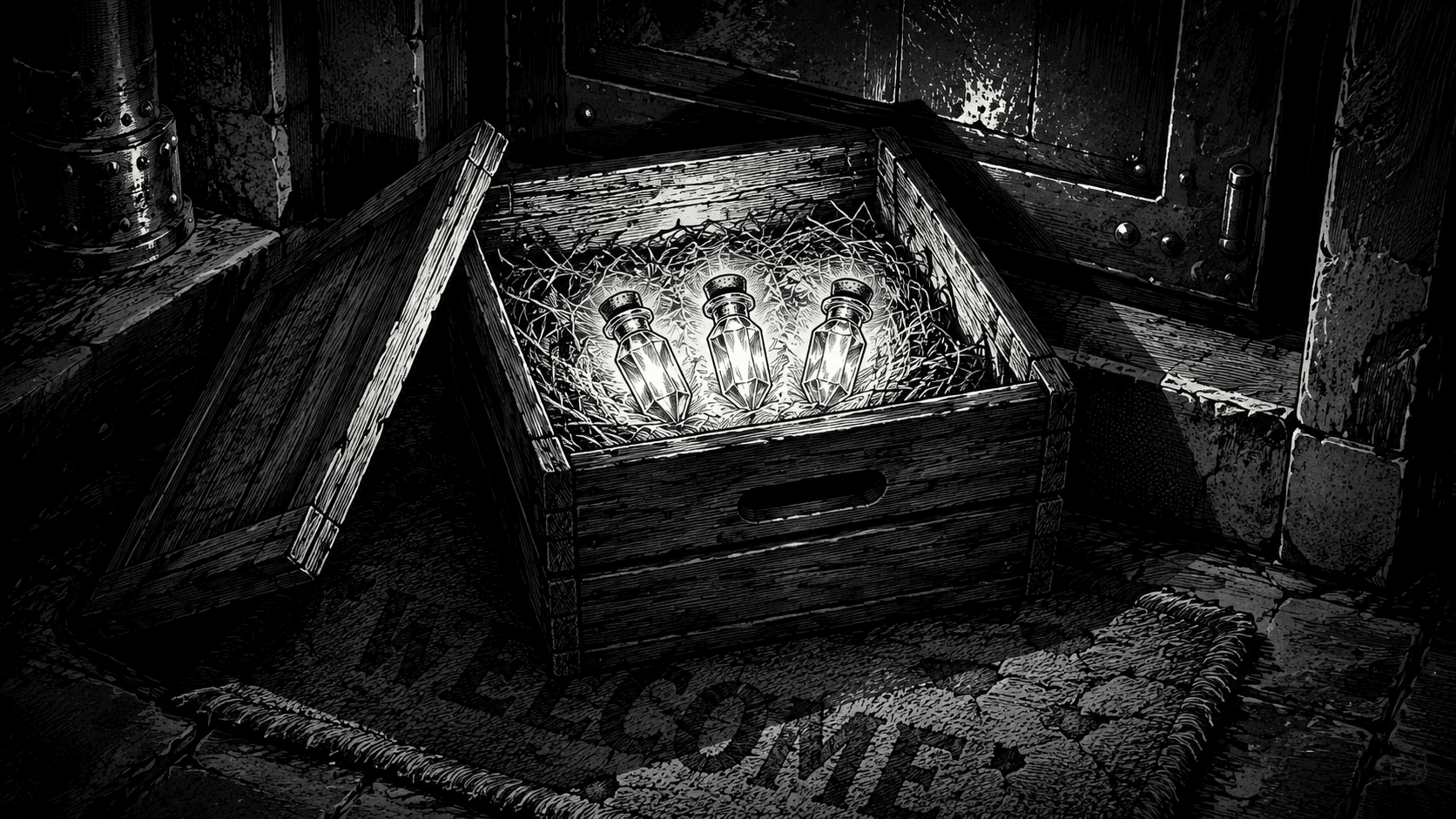
An unmarked wooden crate.
When opened, you find it carefully packed with hay, the way you pack something to withstand a hard landing.
Inside it, small glass vials, each made of crystal. Each faintly glowing. Not the sharp glow of gaslight, not the flicker of an alchemical lamp. Something softer. Warmer. The kind of light that looks, if I’m honest, like it’s thinking about you.
The courier never explains it. Doesn’t know to, half the time. They’re told only that the deliveries are “medicinal,” that quiet pays better than loud, and that they are absolutely not to go peeking.
So I did what any respectable Fishis scribe would do: I followed that trail.
One route I traced back far enough ran the better part of two decades. Hundreds of boxes, same courier, same silence.
Not once has a name been left behind. Not the giver’s. Not the network’s. The lower districts have taken to calling it one thing among themselves, quietly:
The Hand.
The Part Nobody Asks
Here is the detail that should bother you more than the miracle does.
There is a list.
Somebody, somewhere, decides which household gets the crate and which one does not. I have never met a family on the list who could tell me why they were chosen. I have met several off it who wanted very badly to know why they weren’t.
That is not a small thing to hold. Deciding who lives easier and who keeps coughing, on paper, in a drawer, in a hand nobody’s ever shown me.
I went looking for the person. I am curious who could make a call like that and sleep afterward.
I have not found them.
I’m not certain I want to, yet.
An Old Theory I Can’t Prove
The historian in me refuses to leave this where I found it.
I have seen this shape of healing once before, during a crisis that nearly took a dear friend of mine. The Evolu named Daxänu, who my own children affectionately call “Uncle Dax,” had been abused and poisoned, I’m sorry to say, by my own race. Within the protected walls of the Iskäri’s Sanctuary, Dax was at death’s door. A tall order of healers arrived in that hour, led by a spokesman known only by a title rather than a name.
The Hand.
I cannot prove the crates in District 9 come from the same hand that stood over Dax’s sickbed. The timeline is generous enough to allow it and stubborn enough not to confirm it. Evolu healers do not typically involve themselves in gnome tenements. Likewise, gnome couriers do not typically carry the caliber of medicine an Evolu healing circle could produce.
...and these gnome stories greatly precede the incident with Dax.
And yet.
A name repeating itself across decades of my own research is not, in my professional opinion, a coincidence I’m allowed to ignore.
I’ve flagged it. I’ll keep pulling the thread. When I have more than a theory, you’ll have more than a theory.
What This Actually Means
Somewhere in this world, healing exists that Clockworks medicine cannot touch. Somebody has access to it. Somebody has decided to share it, quietly, at real personal risk, through a network of gnomes too poor and too proud to ask questions they were told not to ask.
And somebody else, further up the chain, is making the coldest decision in this whole account: choosing who gets to keep living. They’re choosing it without ever having to look the ones left off the list in the eye.
That second person is the one I actually want to find.
Not to expose them.
I’m not certain the world’s better if I do.
Just to ask them, gnome to gnome, how they carry it.
*Höbin Luckyfeller is a FieldScribe historian and the author of the Wanted Hero Field Guide series, published by the Fishis Archive Foundation. He is still tracing the hand behind The Hand, and has been wrong about easier things than this.*