


Made with AI trained only on my own artwork. The honest story of how, and why →
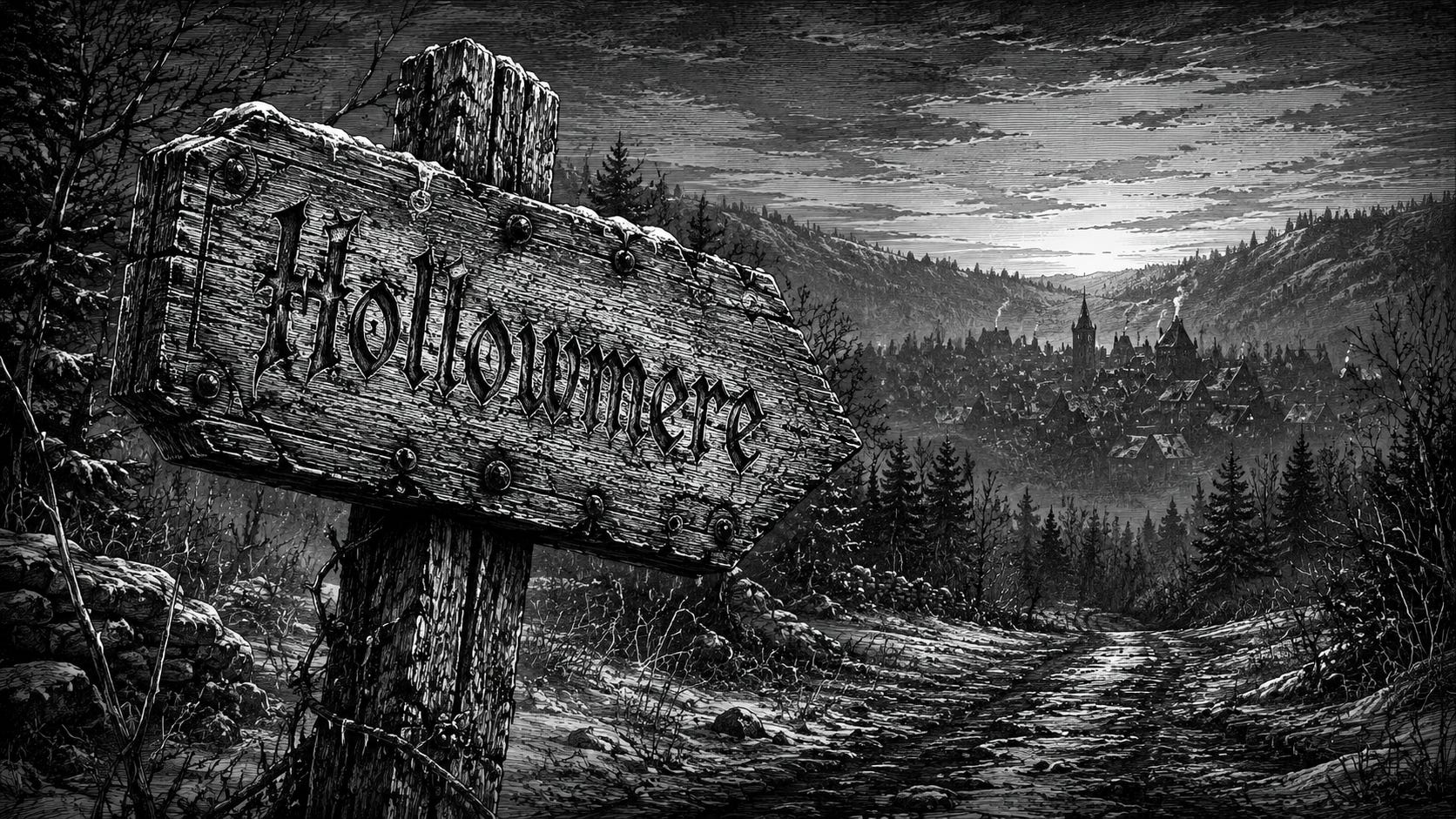
Nobody in Hollowmere believed the old rhyme anymore.
Wren Aldren certainly hadn’t, not really, not until the night the raiders’ fires showed up on the ridge and every able hand in the village came back from the fight with less blood in them than they’d left with.
Her grandmother used to sing it to her as a child, the way you sing something you love without quite believing it:
One kindness paid, one word is owed.
Call it once, down the old road.
Three true names, spoken plain.
Skarvane answers. Once again.
A nursery rhyme. That’s all it had ever been.
Until it wasn’t.
Here’s the story behind the story, the one Wren’s grandmother told better than anyone.
Four generations back, a shepherd named Colm Aldren found a wyrmling half-starved in a snowdrift above the treeline, wing torn, too weak to fly home to wherever home was. Hunters were already climbing the ridge with spears, drawn by the smoke of the creature’s panicked breathing.
Colm hid it in his shepherd’s hut. Fed it goat’s milk from his own hand. Told the hunters the smoke had been his own hearth fire, carried strange on the wind.
When the wyrmling healed enough to fly, it didn’t just leave.
It spoke.
Not the shepherd’s tongue. Something older, that settled into his mind like a stone into water and left the meaning behind once the ripples cleared.
You spent a kindness on me that cost you everything you had to lose.
I have very little left to give a creature so small and so short-lived.
But I can give you this. One word, kept. Call it once, when nothing else is left. I will come.
Then it was gone, and Colm Aldren spent the rest of his life being laughed at gently by neighbors who loved him and didn’t believe a word of it.
Four generations is a long time to keep believing in a debt nobody’s ever seen paid.
Long enough that most of Hollowmere had quietly filed the rhyme next to stories about the man in the moon.
“It’s a nice thing to sing to babies,” old Ansel said, the night the raiders’ watch-fires first appeared on the ridge, “and that’s the whole use it’s ever had.”
“Grandmother believed it,” Wren said.
“Your grandmother also believed the well water cured warts.”
“It does cure warts.”
“That’s beside the point.”
The raiders hit at dawn on the third day. Not many of them, maybe thirty, but Hollowmere had never needed more than a fence and a prayer to keep itself safe, and thirty armed strangers is thirty more than that fence was built for.
The first attempt was the village standing together at the gate, farmers and shepherds with hunting bows and their fathers’ rusted swords.
They held for an hour. Lost six people doing it. The raiders pulled back at dusk only because they’d rather burn the grain stores than fight in the dark, and burning takes less courage than fighting does.
The second attempt was worse. A message rider sent for help from the garrison two days south, except the garrison had its own troubles that spring and sent back word that Hollowmere would have to hold on its own a while longer.
A while longer wasn’t a thing Hollowmere had.
By the second night, half the village was already talking about the road east, about leaving everything behind rather than staying to lose it burning.
That’s when Wren’s grandmother, too old and too tired to fight, gripped her hand across the kitchen table and said the only true thing she had left to offer.
“Climb the ridge. Say the names.”
“Grandmother, it’s a rhyme.”
“It’s a debt,” the old woman said. “And Aldrens have never once, in four generations, let a debt go unspoken. Even the ones owed to us.”
Wren climbed alone, at first light, while the village argued below about whether to run or die standing.
The ridge was farther than she remembered from childhood walks. Steeper, too, the kind of climb that makes you reconsider every choice that led you to it.
She reached the place where the rhyme said to stand, an outcrop of black stone scarred with old claw marks gone smooth with weather, and she felt extraordinarily foolish.
She said the names anyway.
Three true names, the ones her grandmother had made her memorize as a girl, syllables that felt wrong in a human mouth, too many consonants crowded too close together.
Nothing happened.
No wind. No shadow crossing the sun. Just the ridge, and the smoke rising from Hollowmere below, and thirty raiders’ watch-fires waiting to become thirty raiders’ torches.
She said the names again. Louder. Then a third time, voice cracking, because the rule of three is the rule of three even when you don’t believe in rhymes.
Still nothing.
She sat down on the black stone and put her face in her hands, and for the first time since the fires appeared on the ridge, she let herself cry.
It was never real. Grandmother’s dying and she’s dying believing a story, and I climbed a mountain for nothing, and Hollowmere burns tonight because I wasted the one morning I had.
She almost missed it. The change in the light.
A shadow, moving wrong for a cloud, too fast, too deliberate, sliding across the ridge like something pouring itself downhill.
She looked up.
Skarvane was not what four generations of bedtime stories had prepared her for.
Old. That was the first thing. Old in a way that had nothing to do with size, though the size was considerable enough, wings that blotted out half the visible sky. Old in the eyes, in the slow, careful way it folded itself onto the outcrop like something that hurt to move and had decided to move anyway.
Scars crossed its flank in old, pale lines. One eye had gone milk-white, blind.
You took your time calling.
The voice arrived the way Colm’s had arrived, four generations of story-telling ago. Not sound. Meaning, settling in like water finding its level.
“I didn’t think it was real,” Wren whispered.
Neither did your great-grandfather’s neighbors. That never once changed what I owed.
It looked past her, toward the smoke.
Thirty of them. Armed. Your village burns tonight if nothing changes.
“Can you stop it?”
The dragon was quiet a moment. When it spoke again, something in the meaning felt heavier than before.
I am old, small Aldren. Older than I look, and I did not look young to begin with. This will cost me more than it would have cost me a hundred years ago.
“Then don’t.”
A word given is a word kept, Skarvane said, or it was never a word at all. Only noise a dying thing made to feel less alone.
What happened on the ridge above Hollowmere that night became its own story eventually, one Wren still doesn’t tell the same way twice, because some of it happened too fast to hold onto clearly.
Fire from the sky where no fire should be. Thirty raiders who came expecting farmers with rusted swords and found something out of the oldest nightmares their mothers ever warned them about instead.
They didn’t stay to find out if the nightmare had limits.
By the time the sun came up, Hollowmere still stood. Scorched at the edges. Smelling of smoke that wasn’t the bad kind. Alive.
Skarvane didn’t linger for thanks. Wren found it on the ridge afterward, resting against the black stone, breathing in the slow, careful way of something that has spent everything it had and isn’t sure yet what’s left over.
“You could have died.”
I very nearly did. It has been a long time since I fought anything larger than my own hunger.
“Why keep the promise, after all this time? Nobody would have known if you hadn’t come.”
The milk-white eye turned toward her, somehow more piercing for being blind.
I would have known. And your shepherd fed a starving, dying thing from his own hand and asked for nothing back. A debt like that doesn’t get smaller because nobody’s watching to see it paid.
It rose, slow, wincing, wings unfolding.
Something that had earned every one of its scars honestly.
The debt is closed now, Aldren. Four generations, and it is closed.
“Will we ever see you again?”
Skarvane considered that a long moment, old eyes on the smoke-smudged village below, on the girl who’d climbed a mountain for a rhyme she didn’t believe.
That, it said, was never part of the promise.
But I find I am not in as much of a hurry to leave as I thought I would be.
It didn’t say anything else. Just watched the sun come up over Hollowmere a while longer, an old and terrible and patient thing, keeping company with no debt left to keep.
Wren sat beside it and let it.

Excellent.