


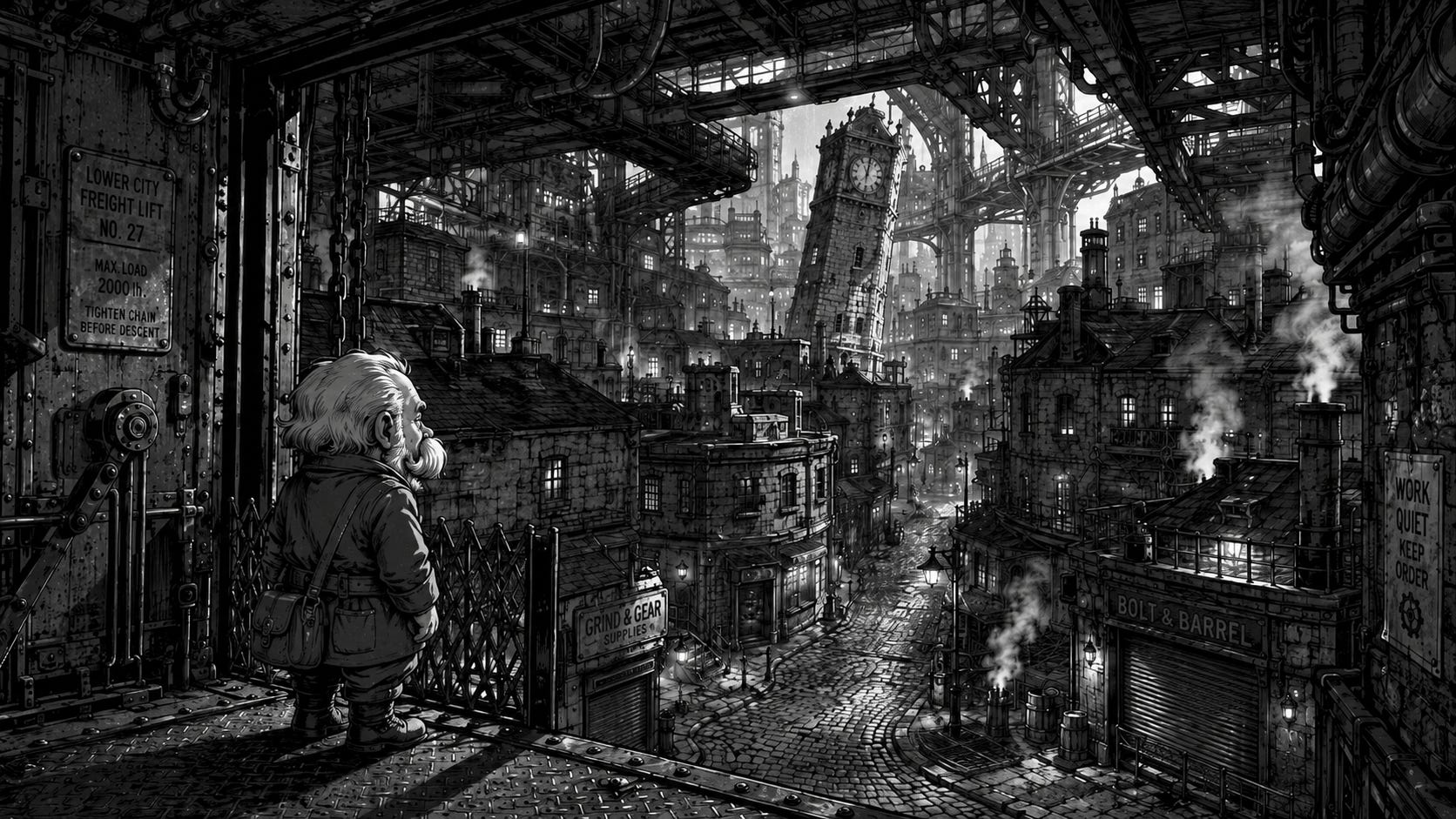
I told myself it was the archive.
That was the reason I gave, anyway.
Clean.
Professional.
Entirely defensible to anyone who might ask, including myself.
The Grandfather District Records Hall holds two centuries of pre-Consolidation census data, guild charters, and land registrations that the FAF hasn’t digitized yet. Important material. Legitimate research. Perfectly good reason to take the lower lifts all the way down to the old city levels.
Nothing to do with the fact that I grew up here.
District 9 hadn’t changed much. That was the first thing I noticed when the lift doors opened and the district spread out below me in the grey morning light. Same cluster of squat stone buildings pressed together like old men sharing warmth. Same narrow streets. Same smell of machine oil and coal smoke that the upper districts like to pretend doesn’t exist.
The clock tower at the center of the old market square still leaned two degrees to the left, which it had been doing since before I was born and would apparently continue doing until someone important cared enough to fix it.
They never would.
The bakery on the corner of Gear Lane and Ninth Main still had smoke rising from its vents, which meant old Perra’s granddaughter had kept the place running.
Both good and bad, I suppose. That summed up my little footprint of District 9 rather neatly.
I paid the lift operator twice what the fare required, because he hadn’t recognized me and that felt like a gift worth rewarding. I was not in the mood for the long version of events.
The Records Hall was a low, wide building wedged between what used to be the mill works and what passed for a district courthouse. Heavy stone. Narrow windows. The kind of architecture that says *we take record-keeping seriously here* in a way that also says *we don’t trust you.* I’d always liked that about it.
The archivist behind the front desk did not look up when I walked in.
“We open at ninth bell,” he said. “It’s eighth bell.”
“The door was unlocked.”
“That’s because I was airing it out.” He still hadn’t looked up. He was copying something from one ledger to another, very carefully, as though the fate of several factions depended on his penmanship. “Please come back at ninth bell.”
I set my satchel down on the counter. The metal arm clinked against the edge. That got his attention.
He looked up.
I’ll give him credit: he composed himself quickly. Gave me the full top-to-bottom assessment, landed on the telescopic eye and the white mustache, and arrived at the correct answer in about four seconds.
“You’re Höbin Luckyfeller,” he said.
“Guilty.”
“The historian.”
“That is my understanding, yes.”
He set down his pen very precisely. “We have three of your books.”
“Which three?”
He blinked. “I...don’t know offhand.”
“Doesn’t matter.” I pulled out my research credentials and slid them across the counter. FAF official seal, current year, full access notation. “I need the pre-Consolidation records. Guild charters, settlement registrations, district boundary agreements. If they’re not catalogued, I’ll work from raw storage.”
He looked at the credentials. Then at me. Then at the credentials again.
“I’ll have to get approval from the Chief Archivist,” he said.
“Of course you will.”
“She doesn’t come in until tenth bell.”
I looked at the ceiling.
Tgii help me, the ceiling hadn’t changed either.
The young archivist seemed to feel he owed me an explanation. “It’s policy. Full access requests require Chief Archivist sign-off. It’s not personal.” He said it the way people say *it’s not personal* when they want to make sure you know it is, in fact, entirely impersonal, which they feel is worse. “If you want to wait...”
I waited.
As I sat in the hard chair by the window, I watched District 9 go about its morning. The mill workers came first, crossing through the market square in pairs, talking in the quick shorthand of people who’ve worked alongside each other for years. Then the shopkeepers, rolling back the iron shutters over their storefronts. Then the school children, which was the worst part, because they were loud and happy and completely unaware that anything had ever gone wrong in the world.
I hadn’t planned to come back. I’d like to be honest about that, at least in my own notes.
The FAF had been asking me to digitize the Grandfather District records for three years, and for three years I’d found other things to do first. There was always another archive, another lead, another corner of the world that needed a competent historian more urgently than a district that already knew my name.
The problem with places that know your name is that they also know what came before it.
District 9 knew about the Bloodsticks years. The long ones. The years I don’t write about in the Field Guides. The years my daughter grew up without me nearby, which I have made peace with in the way that you make peace with a crooked clock tower: it still works, you’ve stopped waiting for it to straighten, but you can’t look at it without knowing.
What did I want from this?
Honestly, I couldn’t have told you.
A researcher’s answer: the records.
A true answer: something else, something I didn’t have a clean professional word for.
To walk these streets and have them be just streets. To eat a roll from that bakery and have it be just a roll. To stand in front of the building where my mother’s workshop used to be and not feel anything in particular.
I’m not sure that last one was ever going to happen.
The Chief Archivist arrived at quarter to tenth bell, which I noted approvingly. She was older than I expected. White hair, cropped short, and the particular posture of someone who has spent forty years defending the integrity of physical records against people who want to handle them carelessly. She looked at the young archivist’s note, looked at my credentials, and looked at me.
“I read your book on the Demoni Vankil,” she said.
“Most people have, apparently.”
“I didn’t like the ending.”
“Most people don’t.” I stood. “Do I have access?”
She studied me for a long moment. The authoritative disparity between us was not lost on either of us, and I want to be clear that I found it entirely reasonable. I was a famous historian with full FAF credentials. She was the Chief Archivist of a district records hall in the lower city. By any external measure, this should have been straightforward. But she held authority over records in her physical custody, in her building, in her district, and no amount of credentials changes who has the key.
That’s how it should work, actually. I’ve said as much in print.
“Full access,” she said finally. “Keln will show you to the pre-Consolidation storage.” She glanced at my metal arm. “Please don’t touch the oldest folios with that.”
“I know how to handle old paper.”
“I’m sure you do.” She turned back toward her office. “There’s a kettle in the reading room. The cups are on the left shelf, not the right. The right shelf cups have a chip problem.”
I almost smiled. “Thank you.”
She paused without turning around. “My grandmother talked about you,” she said. “You came through this district when she was young. She said you were...well.” A small pause. “She said you were both good and bad, depending on the day.”
“That’s fair.”
“She also said you were always honest.”
“Debatable.”
She made a sound that might have been a laugh and closed the office door behind her.
I followed young Keln into the pre-Consolidation storage, which smelled like every old archive smells: dust and dried ink and the particular weight of things that have not been touched in a very long time. I pulled on my cotton gloves and started on the first shelf.
By noon, I had forgotten entirely about the crooked clock tower. I had forgotten about my mother’s recipe for gear rolls, which the bakery had apparently changed. I had forgotten, for several very productive hours, about all the things I didn’t know I wanted.
There was only the record. The careful, patient, irreplaceable record.
This, I have always known. Everything else is complicated.
The work is not.