


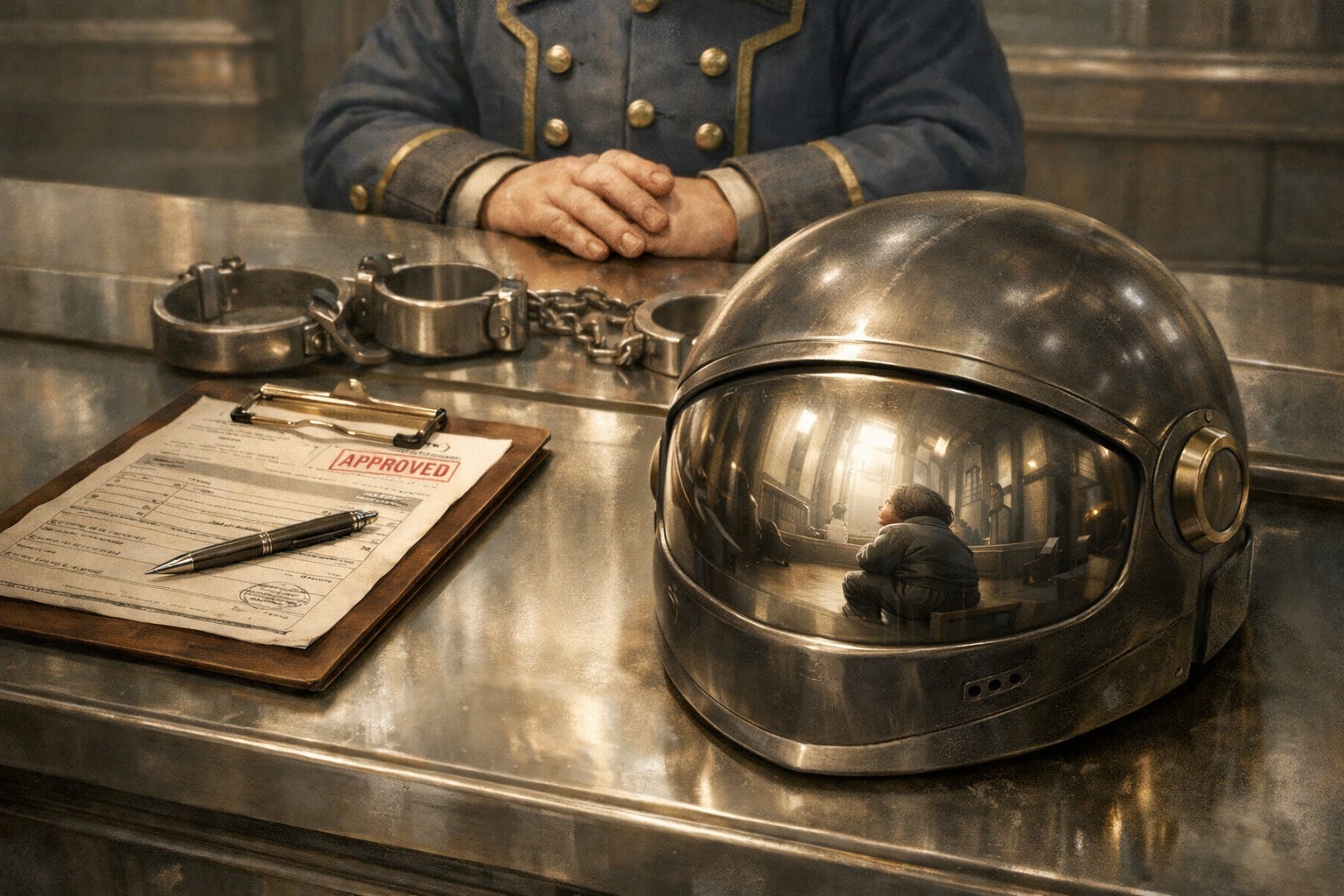
There’s a comforting myth baked into most stories about power:
Violence is loud.
It announces itself with shouting. With threats. With clenched fists and dramatic speeches delivered by people who want you to know they’re the villain.
You’ll notice that Chronicles doesn’t work that way…because real systems don’t either.
In Clockworks City, the most effective violence is polite.
It wears clean cuffs.
It speaks calmly.
It apologizes while tightening the rules around your life.
It offers you a chair before removing your options. It asks you to wait while paperwork is processed. It smiles and nods as your future is quietly dismantled one form at a time.
Politeness isn’t the absence of cruelty. It’s one of its most useful disguises.
That’s the function of the Citadel.
On the surface, it’s order incarnate…symmetry, reflective metal, open sky. Anyone can enter. Anyone can request service. The language of access is everywhere. What’s less visible is the unspoken condition beneath it: your presence is provisional.
Inside the Citadel, shouting is a mistake. Raised voices draw attention. Attention invites witnesses. Witnesses complicate the record.
The real work happens quietly.
A clerk clears their throat.
A guard adjusts their stance.
A number appears on a screen.
And suddenly suffering becomes transactional.
This is polite violence.
It doesn’t bruise knuckles.
It bruises futures.
There is no crime called “knowing too much” in Clockworks City. That would sound barbaric. Instead, there are delays. Misfiled documents. Interviews scheduled without mirrors, without witnesses, without clocks. Silence stretched thin until it becomes a pressure point.
People with loose lips aren’t punished directly. They’re managed.
Isolated.
Redirected.
Buried under process.
And those who learn to stay quiet are praised for their restraint.
This is why silence is mistaken for innocence and noise for guilt.
The system doesn’t distribute violence based on danger. It distributes it based on classification.
Which is why Chuck is indulged.
From the outside, he looks harmless: an old, wealthy eccentric with a loud voice, erratic behavior, and a troubling habit of poking armed officers with a cane. Guards laugh. Clerks sigh. He’s waved through.
That indulgence isn’t accidental.
Chuck understands how systems work because he understands how they categorize. He raises his voice so others underestimate his mind. He behaves unpredictably so procedures fail to slot him cleanly. He offends with charm and disarms with absurdity.
When Chuck is loud, it’s because he wants attention pointed away from something else.
He doesn’t fight the system. He dances just inside the space it refuses to police.
That isn’t luck.
It’s expertise.
Deloris is treated very differently.
She doesn’t shout unless she intends to. She doesn’t perform emotional cues to make others comfortable. She sits. She watches. She lets silence stretch until it becomes uncomfortable—and then sharper still.
In interrogation rooms, silence is more dangerous than anger.
Anger gives authority something to react to. A narrative. A justification. Silence forces projection. It makes interrogators fill the gaps themselves. It unsettles people who rely on control.
Deloris understands this.
When she places knowledge on the table and then pulls it just out of reach, she’s not teasing. She’s setting the terms. She’s reminding the system that while it commands rooms and uniforms, it doesn’t command understanding.
That’s why she’s isolated.
Not publicly punished. Not beaten. Simply removed from witnesses. Reduced to a manageable variable.
Polite violence prefers its victims quiet and unseen.
Nathan and Shamas don’t receive that courtesy.
They’re easy to classify. One is physically vulnerable. The other looks dangerous. Together, they fit a story the system already knows how to tell.
So the violence directed at them isn’t polite.
It’s efficient.
They’re struck because they can be struck. Their pain requires no explanation beyond a checkbox. Their bodies absorb what the system prefers not to examine in itself.
This, too, is by design.
When violence is priced…when it becomes a fee instead of a crime…it stops being a moral question. It becomes a budgeting decision. Credits replace conscience. The question shifts from “Should this be done?” to “Can it be charged?”
Clockworks City answers that question enthusiastically.
Justice isn’t denied here. It’s redefined. If you can afford to exit, you exit. If you can’t, you remain. The process stays immaculate. The harm stays invisible.
Loose lips are dangerous in this environment not because they reveal secrets, but because they threaten the illusion that none exist.
The city doesn’t fear criminals. Criminals are predictable. They make noise. They announce intent. They justify the system’s existence.
What the city fears are variables.
People who don’t behave as expected.
People who don’t fit clean categories.
People who understand the machinery well enough to jam it quietly.
That’s why politeness is enforced. Why decorum is prized. Why disruptions are smoothed over instead of addressed.
A polite system can commit astonishing acts of violence while insisting it has done nothing wrong.
Most harm doesn’t arrive screaming.
It arrives smiling, clipboard in hand, and asks you to wait just a moment longer.
Lets just say,…I wouldn’t recommend Clockworks City as a vacation destination.
-Jaime
Dang!! I'm going to have to cancel my reservation at the Gnaughty Gnome Anomoly Hotel, and Resort.