


Made with AI trained only on my own artwork. The honest story of how, and why →
Some traditions are only love, wearing the clothes of habit so it can walk into every house.
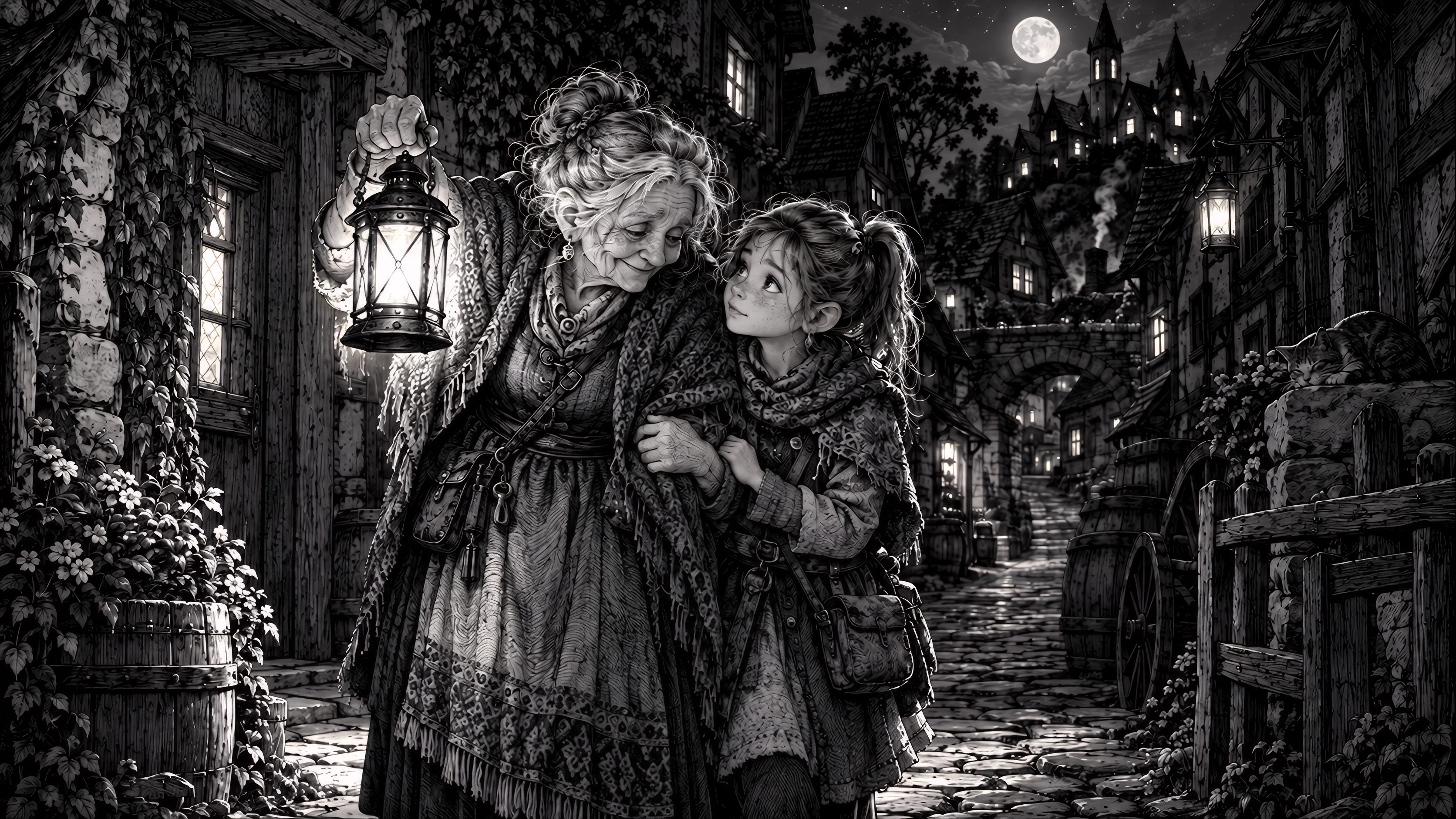
In the town of Dimholt, nobody let a light go out on the dark of the moon.
It was the oldest rule they had. Once a month, on the one night the moon showed no face at all, every household in Dimholt lit every lamp it owned and kept them burning until dawn. Candles in the windows. Lanterns on the porches. A great bonfire in the square that the whole town took turns feeding through the black hours.
They called it Lantern Night.
The children loved it. There was hot cider and songs and no bedtime, and in the morning everyone was tired and happy and a little smoky.
Nobody remembered why they did it.
They only knew you did not, ever, let your light go out.
Nella was twelve, and she had reached the age where you start asking why.
“It’s just a festival, Gran,” she said, helping the old woman set the window candles one dark-moon evening. “A party. Why do you act like it’s so serious? Old Ferro down the lane didn’t even light his this month. Says it’s a waste of good oil.”
Her grandmother’s hands went still on the candle.
“Ferro didn’t light his,” she repeated. Her voice had changed. “You’re certain?”
“He laughed about it. Said the whole thing’s a silly old habit and he’s too sensible for it...”
Gran Brack was already reaching for her shawl.
“Get your coat,” she said. “Now, child. And bring the big lantern, the one that never blows out. We are going to go and have a word with sensible old Ferro.”
Nella had never seen her grandmother move so fast.
...or look so afraid.
They found Ferro’s house dark at the end of the lane.
Every other window in Dimholt glowed warm and gold against the black. Ferro’s alone sat lightless, a single hole of dark in the whole bright town, and the air around his gate was strangely, bitterly cold.
Nella felt it before she understood it.
A chill with no wind behind it. A cold that seemed to come off the shadows themselves.
“Gran,” she whispered. “Why’s it so cold here? It’s not cold anywhere else...”
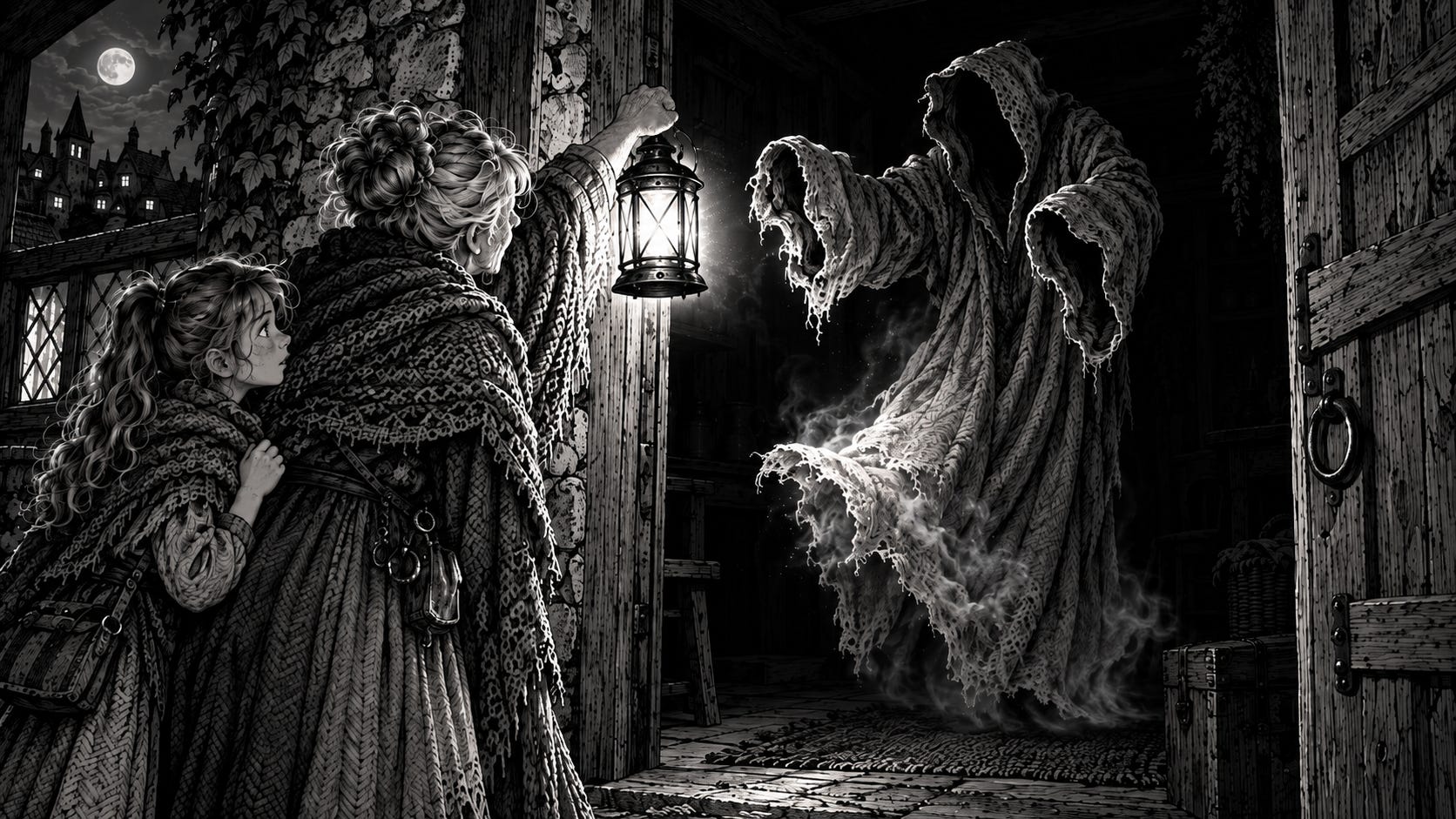
“Because the light keeps them out,” Gran Brack said grimly, holding the big lantern high. “And this fool has opened a door.”
“Keeps what out?”
The old woman did not answer with words.
She pointed.
In the black doorway of Ferro’s dark house, something moved that was not a person. It was tall, and it was wrong, and it was made of cloth.
A robe, hanging in the air with nothing inside it, its empty sleeves lifting slowly toward them. Where a face should have been there was only a deeper dark, and the cold poured off it in waves. Along the hem, where the light from Gran’s lantern touched it, the thing hissed and flinched away.
Nella could not scream. Her whole body had gone to ice.
“Do not run,” Gran said, very low and very steady. “Running is dark and quiet, and dark and quiet is theirs. You stay in the light, child. You stay right here in the light with me.”
Gran Brack raised her voice into the freezing dark, and it did not shake.
“DIMHOLT!” she bellowed, the way you would call a house on fire. “LANTERN NIGHT IS NOT OVER! FERRO’S LIGHT IS OUT! TO THE LANE, ALL OF YOU, AND BRING YOUR FLAME!”
The Robe drifted closer, sleeves reaching, and the cold bit down to the bone.
Then a door opened.
And another. And another.
They came out of every warm house on the lane, the folk of Dimholt, in their nightclothes, carrying candles and lanterns and torches and the burning brands right off their own hearths. They did not fully understand what was happening.
They didn’t need to.
A neighbor had called, and a light had gone out. Every soul in that town had been raised on one single unbreakable rule.
You do not let the dark have a house.
They flooded the lane with light. Gold and orange and blazing white. Torch after torch after torch appeared, until Ferro’s dark doorway was lit up bright as noon.
The Robe shrieked.
A sound like tearing cloth and dying wind.
They drove it back with fire and lanterns, step by shrinking step.
The thing recoiled from every flame, hissing. Its cloth smoldered where the brightest torches came near.
It tried to slither into the shadows between the houses, but there were no shadows left. The whole town had filled them all with light.
It tried to reach the deeper dark inside Ferro’s cold house. Old Marta Finn was already there, and three others, flinging every lit candle they had through the black windows until the inside blazed as bright as the lane.
The Robe had nowhere left to be.
With a last thin howl, it simply...came apart.
The cloth fell empty and lifeless to the ground, a heap of old rag, and the killing cold went out of the air all at once. The lane was only a lane again, full of tired frightened neighbors holding candles in the dark.
Ferro himself stood in his doorway, gray as ash, staring at the fallen rag where a nightmare had been.
“I didn’t,” he whispered. “I only... it was one night. One light. I thought it was a silly old habit...”
“It is a silly old habit,” Gran Brack said. She was shaking now that it was over. “That’s exactly what it’s for, you old fool. A habit so silly and so stubborn that not one soul in this town would ever think to question it... until one did. Until you did.” She looked at the empty robe. “That is the only reason any of us are still here. Because for three hundred years, nobody was too sensible to light a candle.”
They sat up the rest of that night. All of them, in the blazing square.
Gran Brack told the story then, the real one. The one the festival had wrapped itself around so long ago that the town had forgotten there was anything inside it.
Long, long past, she said, the shadow-things had come to Dimholt on the dark of the moon. It’s when their kind is strongest and the world is blackest. They moved through shadow. They fed on the cold and the alone. And a wise woman of the town, who could not fight them with steel, had understood the one thing that could.
You cannot stab a shadow. You can only fill it with light.
So she had made a rule.
Then she made it a party, because a rule you love is a rule you keep.
Light every lamp. Feed the fire. Let no window go dark, and let no neighbor stand alone in the cold. Do it every dark moon, forever, whether you remember the reason or not... and the dark will never again find a single unlit door to come through.
“Three hundred years,” Gran said softly, watching the bonfire. “Three hundred years of a silly habit. And it never failed once... until a man decided he was too clever for the love of the people who came before him.”
Nella looked around the firelit square.
...at the whole tired town.
Ferro lit his lamps every Lantern Night after that. First one on the lane, every single time.
And Nella grew up, and grew old. She became the one who set the window candles and told the story to the children who asked why.
She never once let them think it was only a party.
“The dark is real, loves,” she would tell them, pressing a candle into each small hand. “It waits for the one house that lets its light go out. That’s all it needs. One dark window. One person who decided the old kindness was beneath them.”
She would light the first candle from her own, and pass the flame down the line. Child to child, they passed the flame...exactly as it had been passed to her.
“So we don’t let that happen. We never let a neighbor sit alone in the cold. We keep each other’s lights burning, on the darkest night there is... and we call it a party.”
“But why?” one would always ask.
Nella would smile sweetly. “So that even the littlest of you will never, ever forget to.”
Then she would open the door to the glowing town, and the singing, and the smell of cider on the cold air.
“Come on now,” she would say, taking a small hand in hers. “It’s Lantern Night. Every window lit, every neighbor warm... that is who we are. Let’s go and keep the dark out together, the way they always have.”
