




Tell Me a Mystery and I wanted to do something special for you this Holiday Season, so she, being the brilliant ‘instigator’ (her word, not mine) she is, Anne suggested we recreate a classic and share it with you.
All I had to do was read something.
She’s the talent here, and I’m ever-so-grateful for her.
Hope you enjoy the audio…and if you don’t know the actual story, let me give you some context (copied from HenryLivingston.com):
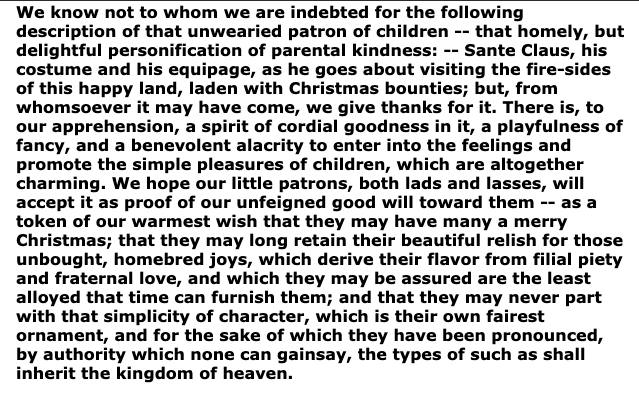
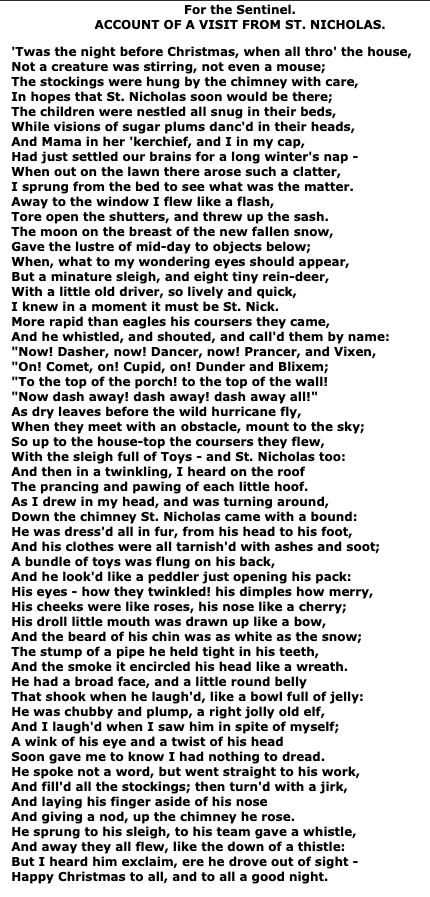


The Poem was Written Around 1807
The date is approximate because it relies upon the memories of the four children who were old enough to remember Henry Livingston reciting it, ink still wet - his sons Charles, Sidney and Edwin, and the neighbor girl who would marry Charles, Eliza Clement Brewer.
After Henry’s death in 1828, the original manuscript, with corrections, was inherited by Sidney, who found it among his father’s papers. Sidney passed it on to his brother Edwin, who moved to Wisconsin and initially lived with his sister Susan and her husband. During one of house fires suffered by Susan’s family, the manuscript burned.
The Poem’s First Known Publication
Although he had published extensively after the death of his first wife, Sally Welles, Henry’s publications mostly stopped with his second marriage in 1793. Surviving manuscript pieces, such as Dialogue, that he wrote for his growing second family, were never published. His major publications of the period were his Carrier Addresses, the New Year poem that was given by the news carrier as a gift to subscribers with the expectation of getting a tip in return. Henry wrote Carrier Addresses from 1787 to 1823.
But now comes blithe Christmas, while just in his rear,
Advances our saint, jolly, laughing, NEW-YEAR,
Which, time immemorial, to us has been made
The source of our wealth and support of our trade,
[1803 Poughkeepsie Journal Carrier’s Address, Adriance Library]But hark what a clatter! the Jolly bells ringing,
The lads and the lasses so jovially singing,
Tis New-Years they shout and then haul me along
In the midst of their merry-make Juvenile throng;
But I burst from their grasp: unforgetful of duty
To first pay obeisence to wisdom and Beauty,
My conscience and int’rest unite to command it,
And you, my kind PATRONS, deserve & demand it.
On your patience to trespass no longer I dare,
So bowing, I wish you a HAPPY NEW YEAR.
[1819 Poughkeepsie Journal Carrier’s Address, Adriance Library]
After Henry’s death, son Charles took back to Ohio a Poughkeepsie Journal printing that he delighted in reading to his children and grandchildren as the work of his father. It was probably this clipping that gave rise to the family stories about an early publication of the poem. Since a version with red-deer instead of reindeer appeared in January of 1828, three weeks after Christmas, as Henry lay dying, it’s possible that this publication was done as a gift to him and was the source of the family stories.
The first known publication of the poem was the one in the Troy Sentinel of 23 Dec 1823.
There is no question that the poem originally came out of the Clement Moore home. For the Livingstons, the question has always been, “How did it get there?”
The Poem Moves from the Moore Household to the Troy Sentinel
There is no question that Clement Moore recited “Account of a Visit from St. Nicholas” to his children as his own work. He also told them not to let it out of the house. But one of the children allowed Harriet Butler, of Troy NY, to take a copy of the poem. In 1844, Moore received a letter from Norman Tuttle, the proprietor of the Troy Sentinel identifying the wife of Daniel Sackett as the woman who gave the poem to the paper’s editor, Orville Holley. The likely assumption is that Harriet Butler gave the copy to Mrs. Sackett.
By the way, Harriet Butler’s brother, Rev. Clement Moore Butler of Troy New York, married Frances Livingston Hart, the granddaughter of Henry’s next door neighbor and cousin, Judith Moore and her husband John Moore!
Why Did Moore Do It?
Moore was known to write Christmas poems. An anonymous poem was identified by attribution researcher and Vassar Professor Don Foster as being by Moore.
“Another possibility, and a better one, is that Mr. Moore wrote Old Santeclaus. If fact, if Old Santeclaus was not written by the original Grinch, Professor Clement Clarke Moore himself, then call me “Rudolph” and never let me play in reindeer games. ... That 1821 Santeclaus poem has the Professor’s stylistic fingerprints all over it. Giving credit where credit is due, I think Moore may be credited with having written one of America’s first Santa Claus poems -- not A Visit from St. Nicholas, but Old Santeclaus.”
Old Santeclaus
Old SANTECLAUS with much delight
His reindeer drives this frosty night,
O’er chimney-tops, and tracks of snow,
To bring his yearly gifts to you.The steady friend of virtuous youth,
The friend of duty, and of truth,
Each Christmas eve he joys to come
Where love and peace have made their home.Through many houses he has been,
And various beds and stockings seen;
Some, white as snow, and neatly mended,
Others, that seemed for pigs intended.Where e’er I found good girls or boys,
That hated quarrels, strife and noise,
I left an apple, or a tart,
Or wooden gun, or painted cart.To some I gave a pretty doll,
To some a peg-top, or a ball;
No crackers, cannons, squibs, or rockets,
To blow their eyes up, or their pockets.
No drums to stun their Mother’s ear,
Nor swords to make their sisters fear;
But pretty books to store their mind
With knowledge of each various kind.But where I found the children naughty,
In manners rude, in temper haughty,
Thankless to parents, liars, swearers,
Boxers, or cheats, or base tale-bearers,I left a long, black, birchen rod,
Such as the dread command of God
Directs a Parent’s hand to use
When virtue’s path his sons refuse.
[From New-Year’s Present to the Little Ones from Five to Twelve. 1821.]
A handwritten manuscript of Moore’s gives another Christmas poem from the same period.
From St. Nicholas
What! My sweet little Sis, in bed all alone;
No light in your room! And your nursy too gone!
And you, like a good child, are quietly lying,
While some naughty ones would be fretting or crying?
Well, for this you must have something pretty, my dear;
And, I hope, will deserve a reward too next year.
But, speaking of crying, I’m sorry to say
Your screeches and screams, so loud ev’ry day,
Were near driving me and my goodies away.
Good children I always give good things in plenty;
How sad to have left your stocking quite empty:
But you are beginning so nicely to spell,
And, in going to bed, behave always so well,
That, although I too oft see the tear in your eye,
I cannot resolve to pass you quite by.
I hope, when I come here again the next year,
I shall not see even the sign of a tear.
And then, if you get back your sweet pleasant looks,
And do as you’re bid, I will leave you some books,
Some toys, or perhaps what you still may like better,
And then too may write you a prettier letter.
At present, my dear, I must bid you good bye;
Now, do as you’re bid; and, remember, don’t cry.
[Museum of the City of New York, Doc #54.331.4.
“Little Sis” was daughter Charity Elizabeth Moore, born 1816.]
It’s possible that Moore had no Christmas poem written and took advantage of the copy left by the governess. Since he had, according to William Smith Pelletreau’s 1897 biography, told the children not to let the poem out of the house, he might have felt it was safe to read the wonderful verses to the children he dearly loved. After all, who would ever know.
So now you know, …and knowing’s half the battle…G.I. Jo—-
Oof, wrong story.
Sorry.
…but you get my intent.
Love you.
Merry Christmas!
Jaime
Special Thanks to Tell Me a Mystery for sharing her amazing skills to create this for all of us!
This was great! Thanks Ann and Jaime for kicking off the month right. Writers are a funny lot when it comes to our work. Who knew a poem could have such a tale? Merry Christmas!!!!